

Overview
Unique, well-structured product descriptions are how large Magento catalogues earn search traffic and get cited by AI answer engines. AI drafting plus human review is the only way to produce them across thousands of SKUs without months of copywriting. Thin pages, blank descriptions, and copy pasted straight from the manufacturer all look the same to Google and to a language model: nothing worth quoting.
Most stores hit this wall as the catalogue grows. A few hundred products can be written by hand. Ten thousand cannot, so descriptions either stay empty or get filled with supplier boilerplate hundreds of other retailers already publish word for word.
Generate a first draft from each product's own attributes, then have a person approve or edit every one before it goes live. That single workflow fixes thin content, duplicate content, and brand voice at the same time.

Why do unique product descriptions matter so much?
Search engines rank pages they can tell apart. When your product page repeats the manufacturer's supplied paragraph, it competes with every other shop running the same feed, and the page with more authority wins. Yours rarely does.
There are three distinct failures, and they need different fixes.
Thin content is a page with almost no description: a title, a price, maybe one line. There is nothing to index and nothing for a shopper to read.
Duplicate content is the manufacturer paragraph, republished across your catalogue and your competitors. It is not a manual penalty, but it is filtered: only one near-identical copy tends to surface, and it will not be yours.
Manufacturer copy is a specific, common form of duplicate content. It reads like a spec sheet, misses the questions your customers ask, and gives an AI model no reason to prefer your page.
How does this affect AI answer engines?
Generative engines such as ChatGPT, Perplexity, and Google's AI Overviews do not return ten blue links. They read pages, extract passages, and cite a small number of sources. This is often called GEO, generative engine optimisation, and it rewards the same things classic SEO does, only harder. A model picks the passage that answers the question cleanly and stands on its own. Manufacturer boilerplate almost never does, so a description that states who the product is for and one or two concrete specifics is far more quotable, and being quoted is the new version of ranking.
Magento helps here. Core 2.4 emits schema.org/Product microdata on the product page, wrapping the name, SKU, image, and the description attribute itself. The words you write feed directly into the structured data a crawler reads, so the quality of the description is the quality of your structured data.
How do you generate descriptions in bulk without duplicating them?
The raw material is already in Magento: product name, attributes, category, brand, and specs. Good AI drafting turns that per-product data into per-product copy, so no two outputs are identical because no two inputs are.
Step 1 - Start from attributes, not a template
Feed the model the product's real attributes rather than a fill-in-the-blank sentence. A description built from "waxed cotton, 12-pocket, made in Portugal" is genuinely different from one built from "recycled nylon, 4-pocket, machine washable". Template-only generation produces the same trap you started with.
Step 2 - Set a house structure
Decide the shape once: a short opening line, three or four key features, who it suits, and a closing line. A consistent structure reads as deliberate to shoppers and as clean, extractable passages to an AI model. It also makes review faster, because you know where to look.
Step 3 - Write short and long, plus meta fields
Magento holds a short_description and a description per product, edited under Catalog > Products. Generate both, and generate the meta title and meta description in the same pass so the search snippet matches the page. FAQ content, where it fits, gives you another citable block.
Step 4 - Batch by category
Generate a category at a time. A batch of tents shares vocabulary and buyer intent, so the prompt and the review both get sharper, and you can measure the effect before rolling to the next.
Where does the human review fit in?
AI produces the draft. A person owns the publish. Skipping the second half is how stores end up with confident-sounding nonsense on live pages.
Reviewers catch three things a model will not reliably catch itself: factual errors about the product, claims you cannot legally make, and drift from your brand voice. The reviewer does not rewrite from scratch. They approve, tweak a line, or reject and regenerate, which is seconds per product, not minutes. The key control is that nothing reaches the live catalogue until a human clicks to apply it, with the ability to roll a change back if a batch reads wrong.
How do you catch a description that contradicts the product?
Review catches the copy that reads badly. It is much weaker at catching the copy that reads well and is wrong. A description saying "holds 12 litres" on a product whose capacity attribute says 8 is fluent, confident, and a returns problem waiting to happen.
The fix is an automated consistency check: read each statement in the copy, and test it against that same product's own catalogue attributes. You already hold the trustworthy values for size, material, weight and capacity. The description should agree with them.
A check like this sorts every statement it can tie to a named attribute into four outcomes. Supported means a cited attribute value agrees. Contradicted means an attribute directly disagrees. Unsupported means nothing in the catalogue backs the statement up. Implausible means the statement contradicts itself. Only the last three need a person, so a clean product is quiet and a risky one is loud.
Two things matter about how you read the result. First, this is catalogue consistency, not external truth: a clean pass means the copy agreed with the attributes that were checked, never that every claim is independently verified. Second, nothing should be written back to the product automatically. The check flags, a person decides, exactly as with the draft itself.
Where a finding needs a second opinion, low-confidence results can be escalated to a stronger model before they are recorded, and specific-value claims such as a size or a weight can optionally be checked against one external source you configure. Neither should ever turn an unsupported claim into a confident "true", and neither belongs on the storefront: this is an internal review signal.
In practice the workflow becomes: score, generate, review, then check the published copy against attributes on a schedule, so a description that quietly went stale when an attribute changed gets reopened rather than sitting wrong for a year.
What are the common mistakes?
Mistake 1 - Mass-updating one description onto everything
Magento's own Catalog > Products grid has an "Update attributes" mass action that can write a single description value across every selected product. It feels efficient and it is the duplicate-content problem in one click. Use it for genuinely shared fields, never for description text.
Mistake 2 - Shipping AI slop unread
Generic, padded copy ("this amazing product is perfect for all your needs") is worse than a blank field: it dilutes the page and reads as low effort to shoppers and models alike. Every description should contain at least one fact only that product's page would state.
Mistake 3 - Losing brand voice
An unguided model defaults to bland. Set the tone once, whether that is plain, technical, or playful, and hold every draft to it, or your catalogue reads like it was written by ten different strangers.
Mistake 4 - Never measuring
If you cannot see which pages were thin and whether they improved, you are generating in the dark. Track a content quality signal per product before and after.
Advanced: turning content into a system
Once the basic workflow runs, three refinements compound the return.
Score before you generate. Give every product a content quality score across description length, metadata completeness, and structured signals, then work worst-first, fixing the pages costing you the most traffic before touching pages that were already fine.
Close feed gaps in the same pass. Missing GTIN, MPN, or brand values get products disapproved in Google Shopping. The audit that scores your content can flag these too, so one project fixes both organic search and paid feeds.
Regenerate on change. When a product's attributes change, its description and score are stale. Recompute on a schedule so the catalogue stays current instead of decaying between reviews.
Where Moogento Fits
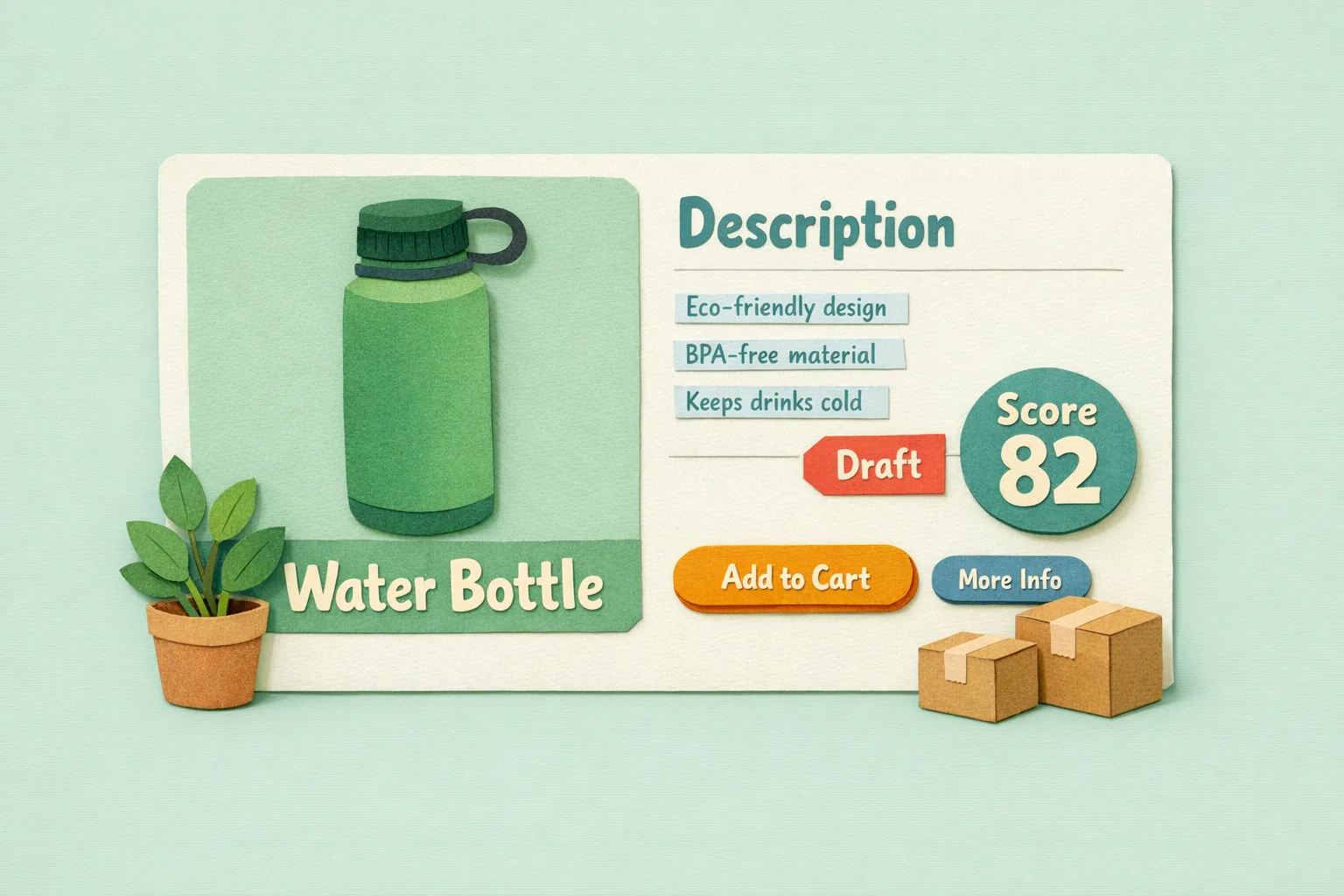
ProductContent AI is built for exactly this workflow. It scores every product from 0 to 100 for content quality, drafts short descriptions, long descriptions, meta titles, meta descriptions, and FAQ content in a brand-voice template you set, and applies nothing until you approve it, with one-click rollback.
It uses the AI provider you already pay for, recomputes scores every few hours so your worst pages stay at the top, and runs the same feed-consistency checks that stop products being rejected from sales channels. It turns "write ten thousand descriptions" into "review a ranked queue".
On the Pro plan it also runs AI Fact Check: it audits your chosen copy fields against your chosen grounding attributes, records only the statements that are contradicted, unsupported or implausible, and gives a reviewer each finding with the exact attribute and value it was checked against. Findings are worked through in Catalog > Fact Check Review, where you can dismiss with a reason, verify a fix, queue a regeneration, or re-check the product. Scheduled re-checks keep it current, per-run and monthly budgets keep the spend bounded, and nothing is ever written to a product or shown on the storefront.
Real-World Impact
Stores that move from manufacturer boilerplate to unique, reviewed descriptions typically see the affected pages start ranking for long-tail, high-intent queries they never appeared for before, because those pages finally say something no competitor's page says.
The gain is largest on the long tail, the thousands of products no one had time to write by hand: little traffic each, a great deal in aggregate. The exact lift depends on your catalogue and starting point, so treat category-level before-and-after measurement as part of the work rather than a claimed percentage.
FAQs
Does Magento penalise duplicate product descriptions?
Magento does not, but search engines effectively do. Google will usually index and rank only one near-identical copy of a manufacturer description, and across many retailers that copy is unlikely to be yours. Unique descriptions are how your product pages become the version that surfaces.
Can I generate Magento product descriptions in bulk with AI?
Yes. The reliable method is to draft from each product's own attributes so every output differs, then review and approve each one before it goes live. Bulk generation without human review risks factual errors and generic copy on live pages.
Where are product descriptions stored in Magento 2?
Each product has a short_description and a description attribute, both edited under Catalog > Products on the individual product's Content section. The description field also feeds the schema.org/Product microdata Magento emits on the storefront.
Will AI-written descriptions hurt my SEO?
Not if they are unique, accurate, and reviewed. Search engines judge the content, not the tool that produced it. Thin or generic AI copy hurts you the same way thin or generic human copy does, so the review step is what protects your rankings.
How do I keep my brand voice across thousands of AI descriptions?
Set the tone and structure once as a template, whether plain, technical, or playful, and hold every draft to it during review. Tools that support brand-voice templates apply that structure to every generated description so the catalogue reads as one brand.
How do I check whether a product description is factually wrong?
Compare each statement in the copy against that product's own catalogue attributes. A statement an attribute contradicts, or that no attribute supports at all, is the one to review. This is a catalogue-consistency check rather than a truth check: it tells you the copy and the data disagree, and a person decides which of the two is wrong.
How do I know which product pages to fix first?
Score each product for content quality, then work worst-first. Sorting by a content score puts the thin and duplicate pages costing you the most traffic at the top, so you spend effort where it returns the most rather than editing pages that were already strong.
Next Steps
- Audit the catalogue and score every product for content quality
- Fix the lowest-scoring pages first, generating short and long descriptions plus meta fields from attributes
- Keep a human approving every draft before it goes live
- Close feed gaps such as missing GTIN and brand in the same pass
- Check published copy against each product's attributes, and review anything contradicted or unsupported
- Recompute scores on a schedule so the catalogue stays current
The highest-value move is scoring first: it turns an impossible "rewrite everything" project into a ranked queue you can actually finish.
Related reading: Magento 2 SEO Guide, How AI Agents Discover, Rank, and Recommend Magento Content, and Magento Sitemaps Done Right.