

How to Prepare Magento Content for AI Shopping Agents

AI shopping agents read your catalogue the way a careful customer would, then summarise or act on it. To prepare Magento 2 content, make every product fact explicit and machine-readable: a clear title, a structured spec table, plain-language answers to the obvious questions, accurate stock and price data, and category pages that state what the category is actually for. The stores that get quoted are the ones an agent can read without guessing.
What is an AI shopping agent, and how does it read your catalogue?
An AI shopping agent is any assistant - a chat model, an AI search result, or an autonomous buying tool - that answers a shopper's question by reading product pages instead of showing a list of links. Someone asks "which of these is quiet enough for a bedroom?" and the agent tries to extract the answer from whatever text and data it can find on your pages.
It reads roughly what a screen reader reads: the visible title, the description text, any spec table, headings, and structured data in the page source. It does not see meaning you only implied through a photo or a layout. If the noise level is printed on an image of the box but never written as text, the agent cannot use it. This is the single biggest gap on most Magento stores - the facts exist, but only a human looking at the page can find them.
Why do some product pages confuse AI assistants?
The same things that make a page hard for a rushed human make it hard for an agent, only an agent has no patience and no benefit of the doubt. The common failures are consistent across stores:
- Facts trapped in images. Dimensions, materials, compatibility, and voltage printed on a graphic but never written as text.
- Marketing where specs should be. A paragraph of adjectives with no measurable attribute an agent can compare against a rival product.
- Vague titles. "Pro Series Bundle - Special Edition" tells an agent nothing about what the product is.
- No answers to the obvious questions. Sizing, care, compatibility, and returns live in a policy page three clicks away, so the agent answers "I'm not sure" and moves to a competitor.
- Stale or missing stock and price signals. An agent that can't confirm availability will hedge, and a hedge is a lost recommendation.
None of this is about writing more. It's about writing the specific, checkable facts a buyer needs and putting them where both a person and a machine can read them.
What makes product content easy for an AI agent to summarise?
Easy-to-summarise content states one checkable fact per line and repeats nothing. Here is the difference, element by element:
| Content element | Hard for an AI agent | Easy for an AI agent |
|---|---|---|
| Title | "Ultimate Home Bundle" | "Bosch 800 Series Dishwasher, 42 dB, stainless steel" |
| Description | Three paragraphs of adjectives | Two short paragraphs, then a spec table |
| Specs | Printed on a lifestyle image | An HTML attribute table with labelled rows |
| Common questions | Scattered across policy pages | A plain FAQ block on the page, answers in full sentences |
| Stock and price | "Contact us for availability" | A clear in-stock state and a numeric price |
| Category page | A grid with no words | A sentence saying what the category is for and who it suits |
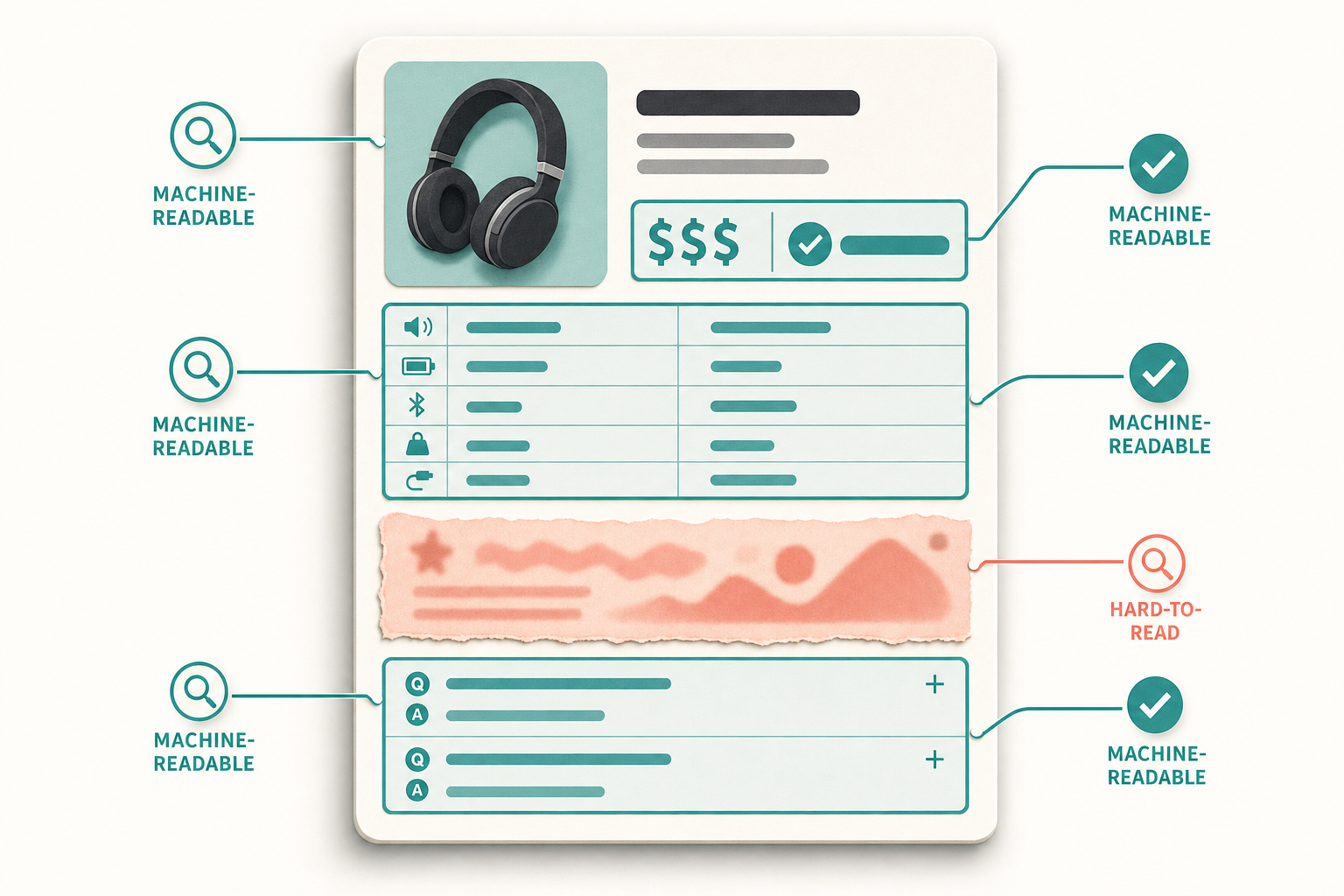
The quotable rule: if an AI assistant summarised your page in three sentences, would those sentences be right? If you're not sure, the page is guessing-fuel, not answer-fuel.
How this applies to Magento 2
Magento 2.4.9 gives you the raw materials but assembles almost none of it for AI readability. Product attributes exist in the catalogue, but whether they render as a clean, labelled table on the storefront depends entirely on your theme and attribute-set setup. Magento's default templates do not emit rich Product structured data with offers, availability, and ratings out of the box - that's theme or extension work. And there's no native product FAQ, so the questions a buyer (or an agent) asks most often usually have no on-page answer at all.
So the Magento-specific readiness work is concrete. Put your real specifications into product attributes and make sure the template renders them as text, not just inside a tab image. Write short factual descriptions. Add a genuine FAQ to high-traffic products. State availability plainly. And give category pages a line of real text explaining what the category is and who it suits, because AI answers frequently start at the category level, not the product. Our own guide to helping AI agents find your Magento store walks the discovery side of this in more depth.
Where Moogento helps
ProductContent AI is built for exactly this gap. It gives every product a content score from 0 to 100 across description length, metadata completeness, FAQ presence, feed consistency, and category signal, so you can sort your worst pages to the top and fix the ones costing you the most. It drafts on-brand descriptions and FAQ content that you approve before anything ships, recalculating scores on a cron cycle (every six hours by default). For category pages, CategoryContent AI adds real above-the-grid text and a FAQ tab, and it outputs FAQPage structured data when those FAQs are present - which is the machine-readable form an AI answer engine can lift directly.
If you want to go further than content and give agents a real interface to your store, AgentCommerce publishes a discovery document at /.well-known/agent-commerce and exposes Magento-native REST and MCP tools for search, cart, and checkout. That's a bigger step than content prep, and most stores should get the content right first - an agent that can transact on a page it can't understand still won't recommend it.
The related discipline here is generative engine optimisation: content prep gets you read, GEO gets you cited. And because agents often arrive at a product through a category or a buying guide, your internal linking decides whether they can reach the page at all.
AI-readiness audit checklist
- Open a top product page and read only the text. Are the key specs there in words, or only on an image?
- Ask a general AI assistant to summarise the page from its URL. Is the summary correct, or does it hedge?
- Check the title: does it name the product, brand, and one defining spec?
- Count the buyer questions answered on the page. Sizing, compatibility, care, returns - are they present, or a click away?
- Confirm availability and price render as clear text, not "enquire".
- Read a category page. Is there a sentence saying what it's for, or just a product grid?
- View the page source and search for structured data. Is there Product or FAQPage JSON-LD, or nothing?
- Pick your ten highest-traffic products and fix those first. Catalogue-wide comes later.
FAQ
Do AI shopping agents actually read my Magento store?
AI search results and assistants already read publicly crawlable pages to answer product questions, and autonomous buying tools are emerging on top of that. If your product facts are only in images or marketing copy, an agent will either skip your page or guess. Writing the facts as text is what lets it quote you accurately.
Is structured data enough on its own?
No. Structured data like Product and FAQPage JSON-LD helps a machine parse facts reliably, but it only encodes what's already written clearly on the page. If the human-readable content is vague, the structured data will be too. Get the visible text right first, then mark it up.
What is the fastest win for AI readiness in Magento 2?
Add a plain FAQ block and a labelled spec table to your ten highest-traffic products. Those two elements answer the questions agents ask most and give them checkable facts to compare, and they help human conversion at the same time.
Does Magento 2 output product schema by default?
Not reliably. As of Magento 2.4.9, whether your pages emit rich Product structured data depends on your theme and any SEO extensions. Many stock and third-party themes emit partial or no product JSON-LD, so it's worth checking your own page source rather than assuming.
Start with one product. Get its page to the point where an AI assistant could summarise it in three correct sentences, then use that page as the template for the rest of the catalogue.


