

Magento Sales Reconciliation: When Two Reports Disagree
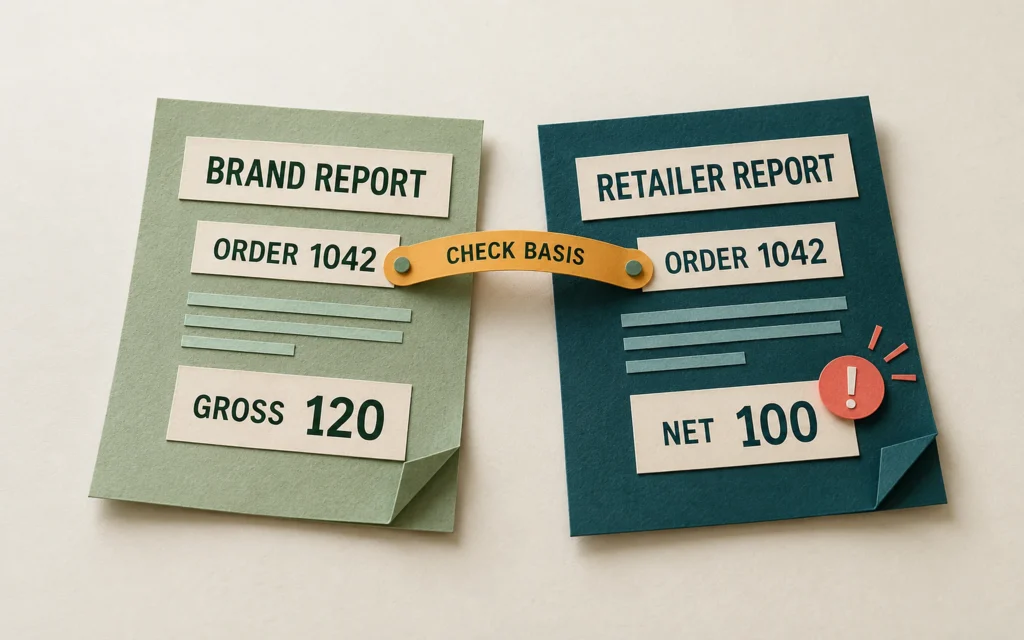
For Magento sales reconciliation, match the same order lines, reporting period, currency and document state before comparing totals with a retail partner. Separate ordered, invoiced, refunded and paid amounts. Give each unexplained difference an owner and an evidence reference. A disagreement between two reports is a reason to investigate, not an instruction to change a price or release a payment.
The E-SHOW Madrid programme, for 4-5 November 2026 at IFEMA Madrid, raises a useful question for brands selling through other businesses. Chen Yue of PHERGAL is scheduled on 5 November at 11:40 to discuss commercial control across manufacturers, distributors and platforms, including data, pricing, stock and margin. Before deciding whose figure should drive the next action, can both sides explain what that figure includes?
Why can Magento and a retailer report different sales?
Magento and a retailer can report different totals while both reports are internally correct. They may count different documents, dates, currencies or adjustments. Define the comparison before deciding that either system is wrong.
Imagine a single hypothetical sale. The brand's report shows 120 including tax. The retailer's report shows 100 excluding tax. If those amounts concern the same transaction and the tax component is 20, the difference is explained without a price correction. Calling both columns "sales" made the comparison look simpler than it was.
Other differences need more investigation. One side may record the order when placed and the other when invoiced. A refund may fall into the next reporting period. The retailer's payment may deduct fees that are absent from the order total. A currency conversion may use a different date or rate.
Write down the meaning of each amount before adding a formula. A spreadsheet can calculate the wrong comparison with impressive consistency.
What should a Magento sales reconciliation match first?
Start with a stable transaction reference and the individual item, then align the amount and reporting basis. A daily grand total can hide several mismatches that happen to cancel each other out.
| Comparison field | Check before accepting a match |
|---|---|
| Order and partner reference | Connect the Magento order number to the retailer's reference. Keep both original values. |
| Item identity | Match the order line and SKU mapping. Distinguish repeated items and split quantities. |
| Period and timezone | Use the same start and end boundaries, timezone and date type, such as order date or invoice date. |
| Currency | State the transaction currency, comparison currency and conversion basis. |
| Amount definition | Separate tax, discounts, shipping, fees and refunds instead of hiding them inside a net total. |
| Document state | Identify whether the quantity or amount is ordered, invoiced, refunded or settled. |
Keep unmatched records visible. A missing partner reference should become an exception to resolve, rather than an approximate match based only on the same amount. Two customers can buy the same product for the same price.
If the disagreement concerns the product's description, accepted price or supplier-provided attributes, use our product data ownership guide. Sales reconciliation has a different job: explaining the transactions that already happened.
Are orders, invoices and credit memos interchangeable?
No. A Magento order, invoice and credit memo describe different stages of a sale. Choose the documents that fit the question being answered, then keep their references connected.
Adobe's invoice documentation explains that one order can have multiple invoices, including invoices for different subsets of its products. An order-level quantity therefore does not establish how much has been invoiced at a particular cutoff.
A credit memo records a full or partial refund. For a comparison after returns, identify which adjustment belongs to which item and which period. Keep the payment provider's settlement evidence separately when checking actual money movement.
Suppose an order contains three units, two have been invoiced, and one of those has a later refund. Reports based on ordered quantity, invoiced quantity and invoiced quantity less refunded quantity answer three different questions. Label the quantity basis in the handover so nobody has to reconstruct it from the file name.
The physical return is another record. Our partial returns guide covers receipt, refund and resale decisions. Here, the relevant task is linking the financial adjustment to the comparison without treating a parcel receipt as proof of a completed refund.
How can an export accidentally count the same order twice?
A product-row export can repeat an order's total on every item row. Compare item amounts at item level, and count an order total once per order when building an order-level summary.
In ExportEasy, a template containing product-level fields can produce rows for individual top-level order items. An order-level field such as grand total still comes from the order. If an order with a total of 120 appears on two product rows, adding that total column produces 240. The extra sale exists only in the calculation.
Inspect a small sample containing a multi-item order before accepting a larger export. Check what one row represents, which columns belong to the item and which belong to the whole order. Agree how configurable or bundled products are represented in the files being compared.
ExportEasy can supply Magento order numbers, related invoice and credit memo references, quantities and financial fields for this work. Check the ExportEasy documentation for your template and plan requirements, including product-row options. The export provides evidence; your reconciliation process still needs the partner's records, matching rules and exception decisions.
Who should decide what happens to an unexplained difference?
Assign the difference to someone who can investigate it and identify the person authorised to approve the resulting commercial change. Finding a mismatch and approving a price, stock or payment adjustment are separate responsibilities.
Use one exception record with the two transaction references, disputed field, expected basis, actual difference, supporting documents, owner and next review date. Record the explanation when it is resolved. Preserve the original files and the corrected comparison so another person can follow the decision.
For example, if the retailer's report includes a refund that has not appeared in the brand's comparison, establish the refund reference and cutoff before changing the brand's sales figure. If a price genuinely differs, route it to the agreed commercial approver with the affected transactions attached. Do not let an unmatched row quietly become a new price.
Automate the repeatable checks after the basis is agreed: exact references, duplicate detection and missing fields are useful starting points. Leave unresolved commercial decisions visible to their owners. A successful file import does not mean the two businesses agree.
What would we bring to the E-SHOW Madrid discussion?
Bring one disputed sale and ask who can explain and approve each commercial decision it exposes. Chen Yue's announced discussion of data, pricing, stock and margin makes that a practical question for a brand selling through a retail partner.
E-SHOW's programme also includes a Carrefour Links session with Jesús Sancho and Juan Fonseca López-Belmonte on 4 November at 13:05, concerning retailer and supplier collaboration through transaction data. Shared data is useful only when the receiving team understands what it measures.
Before the event, choose one recent reporting difference and trace it from the Magento order to the partner's record. Can someone outside the original email thread explain it? Start there. That is a more useful test than comparing two impressive totals.
FAQ
Should a Magento sales report match a retailer payout?
Not automatically. A payout may include timing differences, fees, refunds or other adjustments. Compare the settlement statement with the relevant transactions and agreed deductions, rather than treating the Magento order total as the expected bank receipt.
Which date should sales reconciliation use?
Use the date type that answers the comparison's question, such as order date for orders placed or invoice date for invoiced activity. Agree the timezone and period boundaries with the partner. Keep refunds and later adjustments identifiable when they fall into another period.
Can I add the grand total column in a product-row export?
Check whether that total repeats for every item in the order. If it does, count it once per order for an order-level report. Use appropriate item-level fields for a comparison by SKU or order line.
Does ExportEasy automatically reconcile retailer sales?
ExportEasy supplies Magento-side records for the comparison. The workflow described here also requires partner data, agreed matching rules and an owner for exceptions. Verify those steps before using the result to trigger a commercial action.