

How to Build a Simple "Give & Get" Referral Program in Magento

A give-and-get referral program rewards an existing customer for sharing a link and rewards the friend who buys through it. In Magento 2 you can run one without a full loyalty platform: issue the reward as store credit or a gift-card code rather than a discount coupon, gate the friend's reward behind a minimum first order, and add a couple of anti-abuse rules so the scheme pays out to real referrals only.
What is a give-and-get referral program?
A give-and-get program has two rewards from one referral. The "give" side rewards your existing customer for introducing someone; the "get" side rewards the new customer for their first order. Both rewards usually land as store credit or a gift-card balance rather than a percentage discount, because credit is easier to control and it pulls the customer back for a second purchase.
The appeal for a Magento merchant is that it's cheap to run and self-selecting. You only pay a reward after a real first order clears, so the cost sits against acquired revenue rather than an ad budget you spend up front. The hard parts are the incentive maths and stopping people gaming it, which is where most homemade schemes fall over.
What incentive should you offer?
Match the reward to your average order value and margin, not to what a competitor advertises. A flat store-credit amount on both sides is the simplest structure and the easiest for customers to understand. Percentage-off referrals read as bigger but cost you more on high-value carts and train customers to wait for a code.
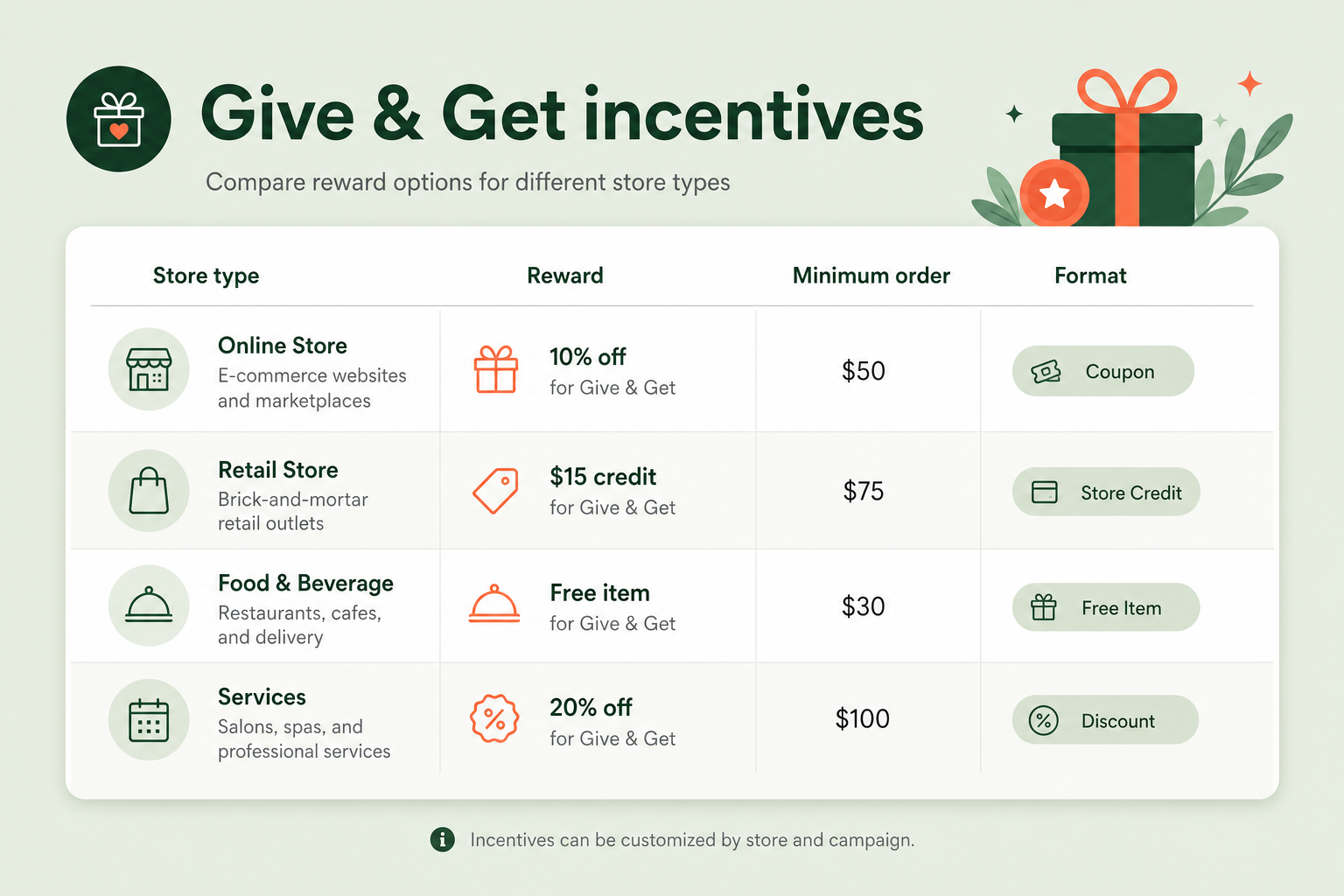
| Store type | Typical AOV | Sensible give/get | Reward format |
|---|---|---|---|
| Pet supplies (repeat, low margin) | £30-£50 | £5 give / £5 get | Store credit, min £25 first order |
| Hobby / specialist | £40-£80 | £10 give / £10 get | Store credit or gift card |
| Beauty (repeat) | £25-£45 | £8 give / 15% get | Credit for referrer, one-time code for friend |
| Home goods (considered) | £80-£200 | £20 give / £20 get | Gift card, min £100 first order |
| B2B supplies | £150+ | Credit on next invoice | Account credit, min order threshold |
Two rules keep the maths safe. Put a minimum-order threshold on the friend's reward so a £20 gift card can't be spent on a £22 order for near-free stock. And prefer store credit or a gift-card balance over a live discount code, because credit is spent in a controlled second visit and doesn't stack unpredictably with other promotions.
How should the reward reach the customer?
Deliver the reward automatically, after the qualifying order clears, and tell both people it's waiting. The single most common reason referral schemes feel broken is a lag between "your friend ordered" and "here's your reward", filled with silence. Automate the payout so it fires on order completion, then send a short email that names the balance and shows how to spend it.
Store credit is the cleanest delivery mechanism in Magento terms. Adobe's own store credit documentation covers the Commerce (paid) version; Community Edition has no native store-credit balance at all, so on Magento Open Source you either build a credit ledger or use a module that provides one. Whichever route, the reward should carry a sensible expiry so unclaimed balances don't sit on your books forever, and the expiry email should go out before the balance dies, not after.
How do you stop referral fraud?
Assume someone will try to refer themselves, and design the rules so it doesn't pay. The three defences that catch most abuse are cheap to build: block self-referral (the referrer and the friend can't be the same account or email), rate-limit reward claims so a script can't hammer the endpoint, and gate the reward behind a real, paid first order rather than account signup.
Layer eligibility on top if your margins are thin. Requiring the referrer to be an established customer - a lifetime-spend floor, a minimum order count, or a left review - stops brand-new accounts spinning up referrals on day one. None of this needs to be visible to genuine customers; it just quietly filters the ones who aren't.
How this applies to Magento 2
Magento 2 Open Source has no native referral or store-credit feature - as of Magento 2.4.9, both are custom or extension territory. Magento Commerce ships store credit and reward points, but even there the referral mechanic (share link, attribution, two-sided payout, fraud rules) is something you assemble. So the practical build on any edition comes down to four pieces: a shareable referral link tied to the referrer, attribution that records which new order came from which link, an automatic two-sided payout in credit or gift-card balance, and the fraud rules above.
Keep the reward off Magento's SalesRule (coupon) system if you can. Coupon codes stack, leak to voucher sites, and are awkward to expire per-customer. A store-credit or gift-card balance is a ledger you control per account, which is exactly what a referral reward wants to be.
Where Moogento helps
GiftEasy includes a give-and-get referral scheme that follows this shape on any Magento edition. The reward is issued as a gift-card code from its own balance ledger rather than a SalesRule coupon, so it never touches your promotions engine. You set the reward amount and the friend's minimum-order threshold under Stores > Configuration > Moogento GiftEasy > Setup: Give & Get Rewards, and the payout fires automatically on a short cron cycle once the order qualifies, with a welcome email to the new customer.
The anti-abuse rules are built in rather than bolted on. Self-referral is blocked outright, claim attempts are rate-limited (repeated failed claims trigger a temporary ban), and you can gate eligibility on lifetime spend, order count, or a left review so brand-new accounts can't farm rewards. Issued balances carry an expiry (365 days by default) with a reminder email before they lapse, so nothing sits unclaimed on your books indefinitely.
On the economics, ProfitEasy is the sanity check. A referral reward is a real cost of acquisition, and ProfitEasy folds order costs, refunds, shipping and payment fees into a per-order profit figure - so you can see whether a £10-give / £10-get scheme still nets a margin after the friend's first order, rather than guessing. Set your give-and-get amounts against that number, not against a competitor's advertised offer. Both modules, and the rest of the post-purchase toolkit, are documented in the Moogento docs if you want the full configuration detail.
Referral program audit checklist
- Write down your give and your get amounts, then subtract both from a typical first-order margin. If it's negative, the scheme loses money on every referral.
- Put a minimum-order threshold on the friend's reward. A reward bigger than the cheapest qualifying order is free stock.
- Deliver the reward as store credit or a gift-card balance, not a live discount code, unless you have a specific reason to use a code.
- Time the payout to fire on order completion, and send an email that names the balance and its expiry.
- Block self-referral by account and email. Test it by trying to refer yourself.
- Rate-limit reward claims so the endpoint can't be scripted.
- Gate referrer eligibility (spend, order count, or review) if your margin is thin.
- Set a reward expiry and send the reminder before it lapses, not after.
FAQ
Does Magento 2 have a built-in referral program?
No. Magento Open Source (Community) has no native referral feature and no native store credit as of Magento 2.4.9. Magento Commerce ships store credit and reward points, but the referral mechanic - share links, attribution, two-sided payout and fraud controls - still has to be assembled. Most merchants use an extension for this rather than building it.
Should a referral reward be a discount code or store credit?
Store credit or a gift-card balance in almost every case. A discount code stacks with other promotions, leaks to voucher sites, and is hard to expire per customer. Store credit is a per-account ledger you control, it pulls the customer back for a second visit, and it can't be shared publicly.
How do you prevent referral fraud in Magento?
Three rules catch most of it: block self-referral by account and email, rate-limit reward claims so the endpoint can't be scripted, and pay the reward only after a real first order clears rather than on signup. For thin margins, add an eligibility gate - a lifetime-spend floor or minimum order count - so brand-new accounts can't farm rewards.
How big should the reward be?
Set it against your margin, not a competitor's offer. Subtract both the give and the get from a typical first-order margin; if the result is negative, the scheme loses money on every referral. A flat store-credit amount on both sides, with a minimum-order threshold on the friend's side, is the safest starting structure.
Start with the incentive maths. Once you know your give and your get sit inside a first-order margin, the rest is plumbing: a share link, an automatic payout, and three fraud rules you can test in an afternoon.


