

Magento Product Page SEO: A Merchant's Practical Checklist

Magento product page SEO comes down to getting a handful of fields right on every product: a title tag written for a search click, a description that's genuinely about the product rather than a manufacturer's boilerplate, alt text on every image, Product schema so you're eligible for rich results, accurate stock messaging, and internal links to related products and the parent category. Native Magento gives you the fields; the work is filling them properly and at scale rather than leaving the defaults.
What are the highest-impact fields on a Magento product page?
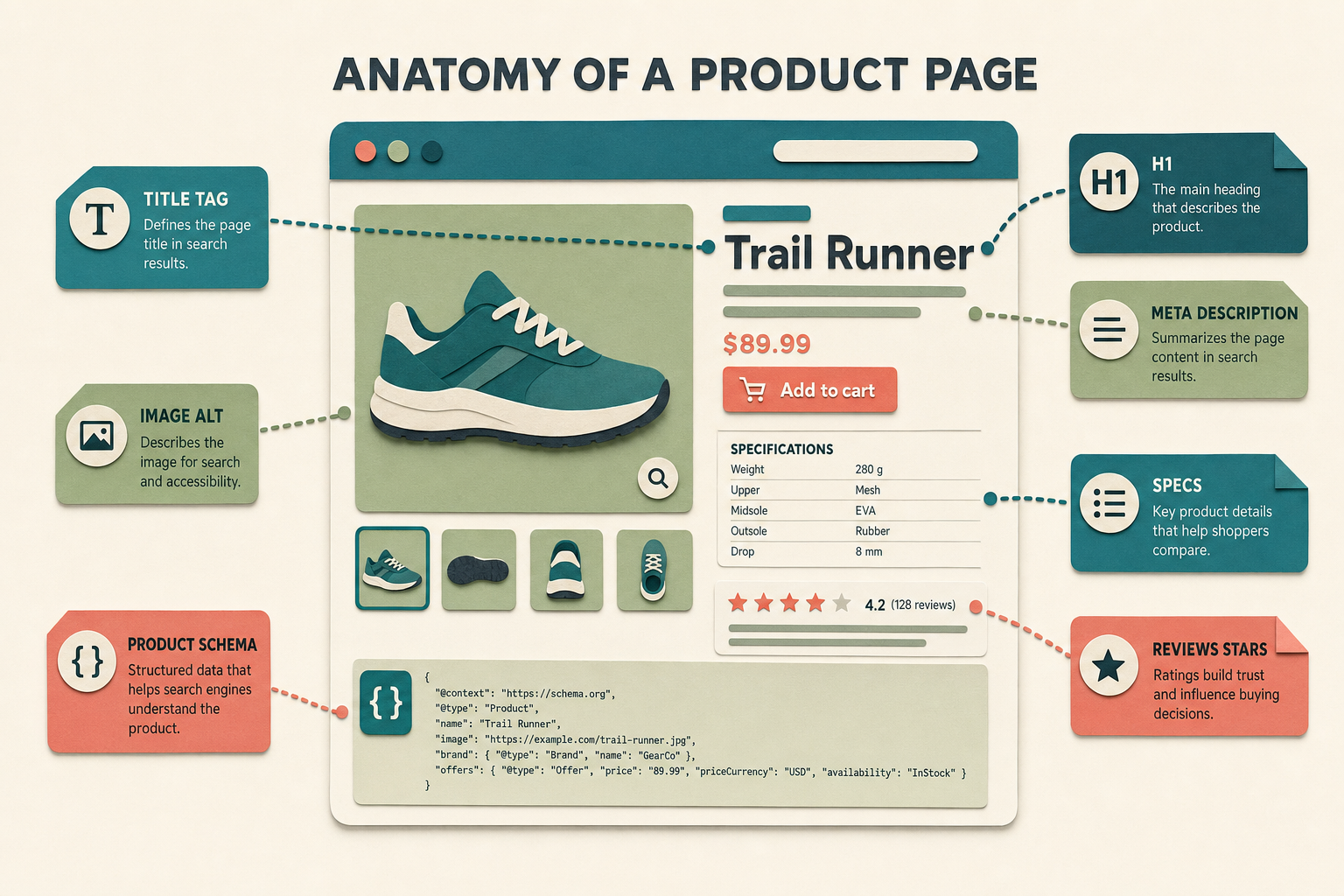
The fields that move rankings and click-through most are the title tag, the meta description, the product description, image alt text, and structured data. Magento exposes the first four directly in the product edit form under the Search Engine Optimization section (Adobe's product SEO docs list them): Meta Title, Meta Keywords, Meta Description, and URL Key. The description fields sit higher up in the form. Structured data is the one native Magento is weak on, and where most stores have the biggest gap.
How should you write product title tags in Magento?
Write the title tag for a human deciding whether to click, with the product's most-searched name near the front. If you leave Meta Title blank, Magento falls back to the product name, which is often fine for a distinctive product and terrible for a generic one ("Blue Widget" tells Google and the shopper nothing). Include the brand, the model, and a distinguishing attribute where they help - "Bosch SGS4HVW33G Dishwasher, 60cm White" beats "Dishwasher".
Keep it under about 60 characters so it doesn't truncate in the results. Don't stuff keywords; one clear, specific title outperforms a comma-separated list of variations every time. Meta Keywords, for the record, do nothing for Google - leave the field alone.
What makes a product description good for SEO?
A good product description answers the questions a shopper actually has and uses the words they'd search, without repeating the manufacturer's copy that's already on fifty other sites. Duplicate manufacturer descriptions are the single most common product-page SEO weakness: if your description is identical to the supplier's and every competitor's, there's nothing for Google to rank you on. The fix is buying-decision content - who it's for, what it's compatible with, how it compares to the next model up - written once per product.
That doesn't mean 800 words on every SKU. A short, specific, original paragraph plus a clean spec list beats a wall of keyword-padded prose. The test: does the description tell a shopper something the product title and photo don't?
Do product pages need schema markup?
Yes. Product structured data (schema.org/Product) is what makes your listings eligible for rich results - the star ratings, price, and in-stock status that show under a result and lift click-through. Without it you're competing for the same clicks with none of the visual advantage. The key properties are name, image, description, brand, offers (price, currency, availability), and aggregateRating where you have reviews.
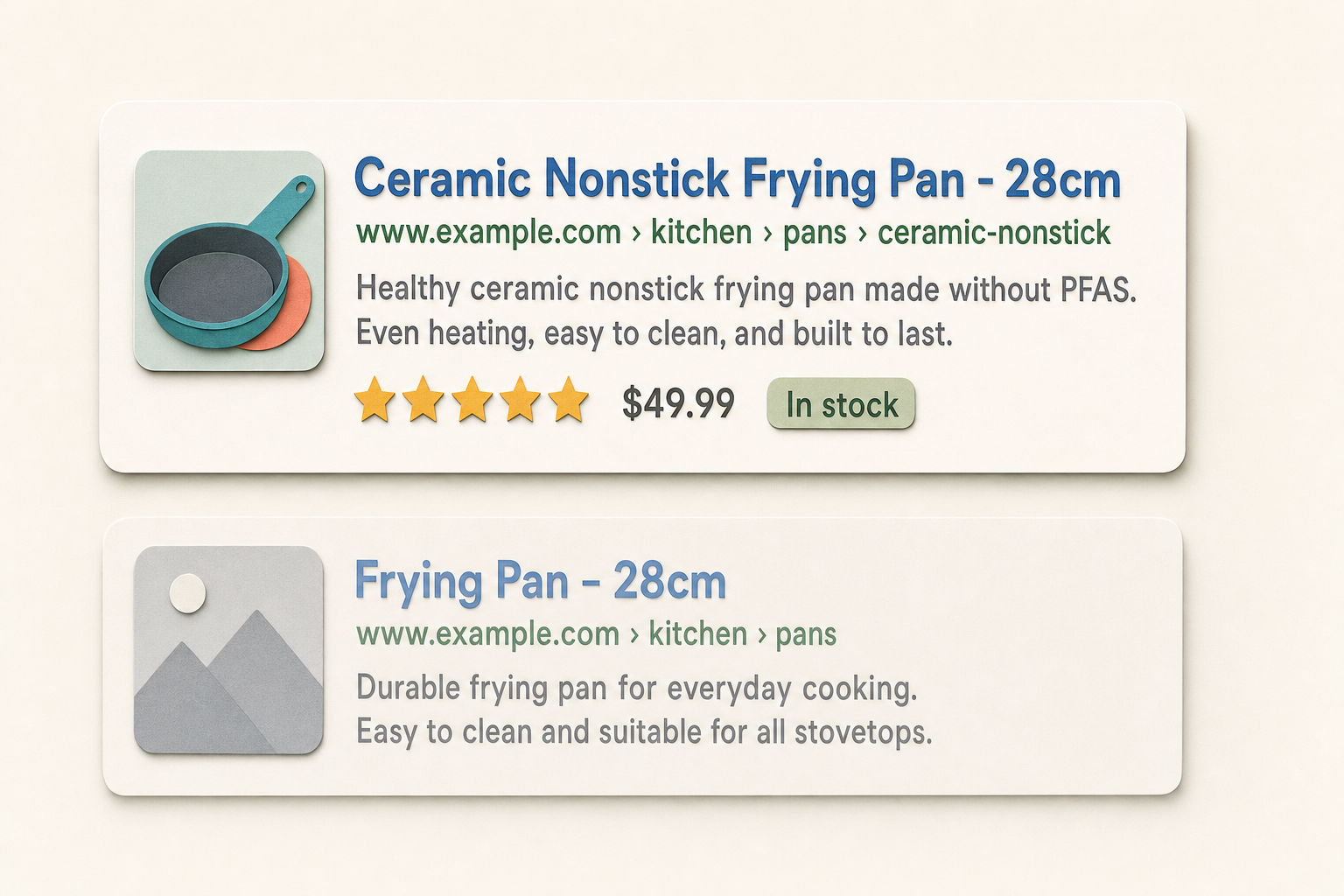
Native Magento's structured data support is thin - it outputs some basic markup but not a complete, validated Product graph with offers and ratings. This is usually the biggest single fix on a Magento product page: add proper JSON-LD Product schema and validate it in Google's Rich Results Test.
How should out-of-stock products be handled for SEO?
Keep temporarily out-of-stock products live and indexed, with clear "back in stock" messaging - don't 404 them or hide them. A product that's out of stock for two weeks still holds its ranking and its backlinks; killing the page throws that away and you start from scratch when it returns. What you want on the page is correct availability in the schema (availability: OutOfStock) and a way for the shopper to register interest so the visit isn't wasted.
Only remove a page when the product is genuinely, permanently gone - and then redirect it to the nearest relevant category or replacement, never leave a bare 404. Getting this wrong at scale (auto-hiding every out-of-stock SKU) is a quiet, recurring SEO leak on busy stores.
The Magento product page SEO checklist
- Title tag: unique, under 60 characters, most-searched product name near the front. Not left to default on generic products.
- Meta description: 120-155 characters, specific, gives a reason to click. Blank is a wasted line in the results.
- URL key: short and readable, no auto-generated ID soup. Set a permanent redirect if you change it.
- H1: the product name, once. Don't let the theme output two H1s.
- Description: original buying-decision content, not the supplier's boilerplate. Specific to this product.
- Image alt text: every image, describing what's shown. This is basic accessibility and image-search visibility in one.
- Specs: real product attributes (dimensions, material, compatibility) filled in, not left empty. They power filters and comparison too.
- Reviews: enabled and surfaced, and reflected in aggregateRating schema.
- Product schema: complete JSON-LD with offers and availability, validated in the Rich Results Test.
- Stock messaging: accurate availability, a back-in-stock path for temporary outages, redirects for permanent removals.
- Internal links: to related products and the parent category, with descriptive anchors.
- Canonical: correct on configurable/variant products so simple products don't compete with their parent.
How this applies to Magento 2
Magento 2.4.9 gives you every field on this checklist except complete structured data - the SEO section, image alt fields, description fields, URL key, and canonical settings are all native. The gap is never the features; it's that filling them by hand across thousands of products is slow, so defaults and blanks pile up. A store with 5,000 products and blank meta descriptions on 4,000 of them isn't missing a tool, it's missing the hours. That's the real product-page SEO problem at scale.
Where Moogento helps
For the structured-data gap, the Sitemap Pro side of the Moogento Sitemap module generates JSON-LD schema for products and categories, including offers and business markup, so you get rich-result eligibility without hand-coding it per template. Moogento's ProductContent module tackles the fields-left-blank problem directly: it drafts short and long descriptions, meta titles, meta descriptions and FAQ blocks for products in bulk, with a brand-voice and forbidden-claims layer so the output matches your store, and every draft goes through an approval step before it publishes - more on that in our guide to improving product descriptions at scale.
On the stock side, NotifyMe is the back-in-stock path this checklist calls for: a "notify me" signup on out-of-stock products so a temporarily unavailable page still captures the visit instead of losing it. And for the category pages your product internal links point at, CategoryContent makes sure they carry real content, so the link equity you pass up from products lands on a page worth ranking.
FAQ
Does Magento have built-in product SEO fields?
Yes. Every product's edit form has a Search Engine Optimization section with Meta Title, Meta Description and URL Key, plus image alt fields and description fields elsewhere in the form. The main thing native Magento doesn't do well is complete Product schema, which usually needs an extension or custom template work.
Should I write unique descriptions for every product?
For products that matter to your rankings, yes - duplicate manufacturer copy gives Google nothing to rank you on. You don't need long copy on every SKU, but a short, original, buying-focused paragraph beats shared boilerplate. On huge catalogues, do the high-traffic and high-margin products first.
Does out-of-stock hurt product page SEO?
Being temporarily out of stock doesn't hurt if you keep the page live and indexed with correct availability schema and a back-in-stock option. What hurts is 404ing or hiding the page, which throws away its ranking and links. Only remove and redirect when the product is permanently discontinued.
What schema should a Magento product page have?
Product schema (schema.org/Product) with name, image, description, brand, offers (price, currency, availability) and aggregateRating where you have reviews. That's what makes you eligible for rich results with stars, price and stock status. Validate it in Google's Rich Results Test after adding it.
Work the checklist in priority order: schema and unique descriptions on your top products first, then meta titles and descriptions across the catalogue. Those two changes account for most of the product-page SEO gap on a typical Magento store.


