

Fixing Thousands of Product Descriptions Without Publishing Junk

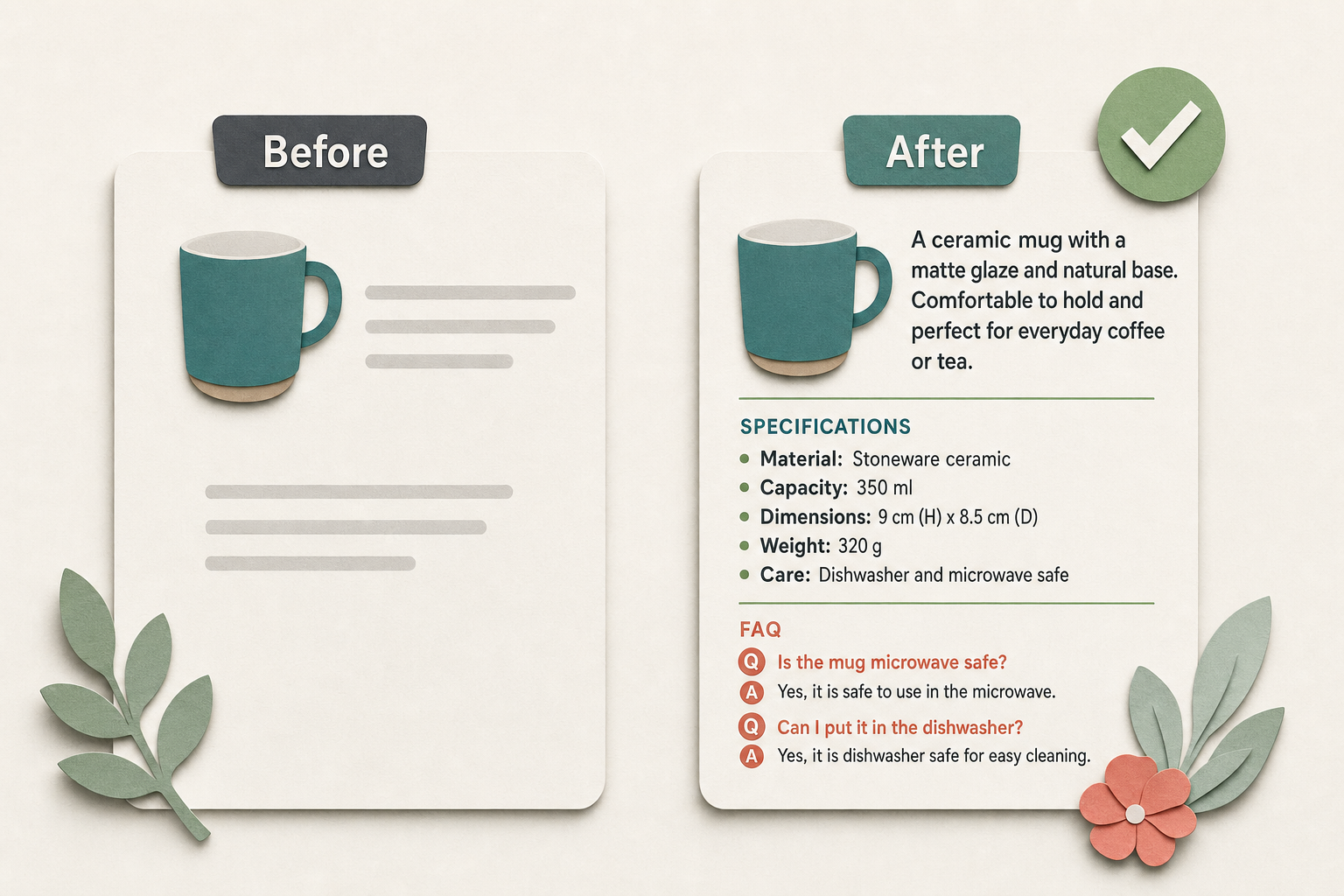
Improving thousands of weak product descriptions is a quality-control problem, not a writing problem. Hand-writing them never finishes; publishing raw AI output at scale trades thin content for wrong content, which is worse. The workable approach is a pipeline: generate drafts against your own rules (brand voice, banned claims, required specs), route them through a review gate, and publish only what passes - auto-approving the low-risk cases and holding the rest for a human. You keep editorial control without doing every SKU by hand.
Why is fixing product descriptions at scale so hard?
Because both obvious approaches fail in opposite directions. Writing original copy for 10,000 products by hand is a project that never ends - by the time you finish, the first batch is out of date and half the catalogue has churned. But pointing an AI at the catalogue and publishing whatever comes out replaces a known problem (thin, duplicate descriptions) with an unknown one (confident-sounding claims that are wrong, invented specs, off-brand tone, made-up compatibility). Both leave you worse off than careful inaction.
The catalogues where this bites hardest are the ones with manufacturer boilerplate copied verbatim across every reseller - the same duplicate-description problem we flag in the product page SEO checklist. Google's helpful content guidance is explicit that content should be written for people and add value beyond what's already out there - duplicate supplier copy does neither. So the pressure to improve is real, and the temptation to bulk-generate junk is exactly why so many stores end up with a different problem instead.
What does a controlled content workflow look like?
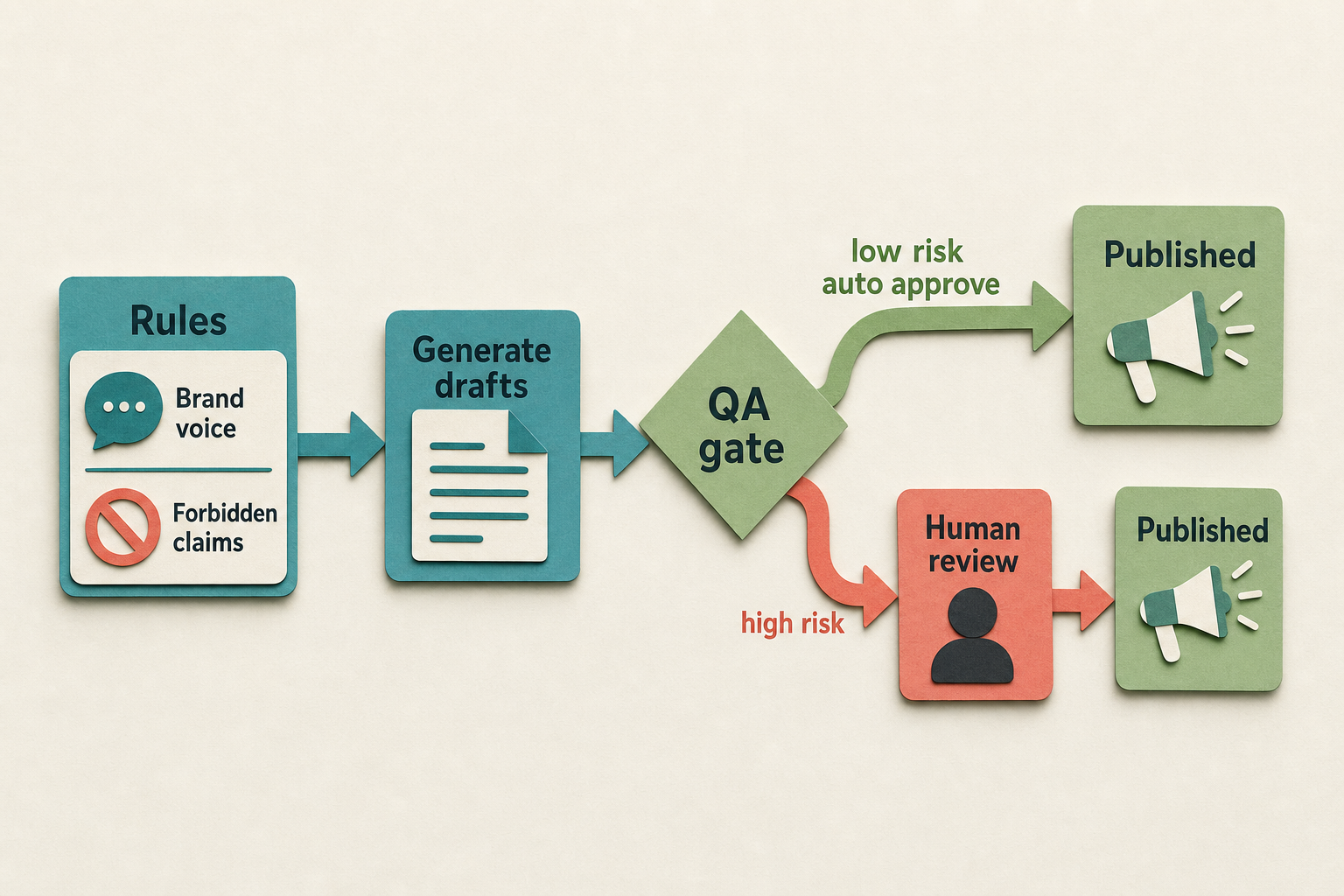
A controlled workflow separates generation from publishing with a review gate in between. Nothing goes live straight from the generator. The stages:
- Define the rules first. Brand voice, forbidden claims (medical, "best", guarantees you can't back), required elements (specs, compatibility), allowed HTML, and any SEO or locale rules. These are the guardrails every draft is held against.
- Generate as drafts, not live content. The output is a proposed change sitting alongside the product, not a published edit. Existing merchant-written content is preserved, not overwritten.
- Score risk. A short factual meta description is low-risk; a long description making compatibility or performance claims is high-risk. The two shouldn't get the same level of scrutiny.
- Auto-approve the safe cases, review the rest. Low-risk drafts can publish automatically; anything touching claims or the products that matter most gets a human read before it goes live.
- Publish, then measure. Track whether the changed pages actually perform, and feed that back into which products to prioritise next.
How do you QA generated content without reading every word?
You QA by rule and by risk tier, not by reading all of it. Reading 10,000 descriptions defeats the purpose. Instead:
- Machine-check the mechanical rules. Forbidden phrases, disallowed HTML tags, length limits, and required elements can all be enforced before a human sees anything. A draft that breaks a rule never reaches the review queue.
- Human-read only the high-risk tier. Products making claims, your top sellers, and anything in a regulated category. That's a fraction of the catalogue, and it's where a wrong description actually costs you.
- Spot-check the auto-approved tier. Pull a random sample weekly. If the sample is clean, the rules are working; if it isn't, tighten the rules, not the volume.
- Never let it overwrite good copy. Content a merchant wrote deliberately should be left alone unless someone explicitly chooses to replace it.
The point is that "control" doesn't mean reading everything. It means the things that can go badly wrong are caught by rules or by a human, and the things that can't are allowed to flow.
How this applies to Magento 2
Magento 2 has no native concept of a content draft or an approval gate for product copy. You edit a product, you save it, it's live - there's no staging of description changes, no rules engine for what copy is allowed, and no bulk-generate step. The nearest native tool is the product grid's mass actions, which can update attributes in bulk but won't write content. So a controlled description workflow on Magento is always either a manual process (a spreadsheet, a copywriter, and a lot of discipline) or an extension that adds the draft-and-approve layer.
Content Staging exists for scheduling campaign content, but it's built for timed launches of curated pages, not for QA-gating thousands of routine product descriptions. For catalogue-wide content work you need something that treats generation and approval as first-class steps.
Where Moogento helps
Moogento's ProductContent module is built around exactly this draft-and-approve model. It generates short descriptions, long descriptions, meta titles, meta descriptions and FAQ blocks in batches, but the output lands as drafts, not live edits. You set the guardrails centrally - store tone and brand voice, forbidden claims, allowed HTML tags, SEO rules, and locale rules - and every draft is generated against them. Existing merchant content is preserved rather than overwritten, low-risk drafts can auto-apply while the rest wait for approval, and the whole run is processed through a queue with batch size, timeouts and retry handling so a large catalogue doesn't choke. It's the workflow in this article, built in.
Two neighbours are worth knowing. CategoryContent does the same job for category pages - the intro and supporting copy that turns a bare product grid into a page worth ranking. And once your descriptions carry real specs and buying detail, the Sitemap Pro schema output can expose them as structured Product data. If you also run out-of-stock lines, NotifyMe keeps those pages earning their improved content by capturing back-in-stock demand instead of losing the visit.
Content QA checklist
- Are generated changes staged as drafts, or do they publish straight to live? If it's straight to live, you have no gate.
- Is there a forbidden-claims list, and is it enforced before review, not after publishing?
- Does the process preserve existing hand-written copy, or silently overwrite it?
- Are products risk-tiered, so claims-heavy items get a human and safe meta descriptions don't?
- Do you spot-check the auto-approved tier on a schedule, or assume it's fine?
- Is brand voice defined once, centrally, rather than hoped for per product?
- Can you measure whether changed pages actually perform, and reprioritise from that?
- Is the batch process resilient - retries, timeouts - so one bad item doesn't stall the run?
FAQ
Can I use AI to write product descriptions without hurting SEO?
Yes, if you gate the output. AI copy hurts SEO when it's published raw at scale - generic, wrong, or duplicated across your own catalogue. Generate against brand and factual rules, review the high-risk items, and publish only what passes, and it becomes a drafting assistant rather than a liability.
Should I rewrite every product description?
No. Prioritise duplicate manufacturer boilerplate on high-traffic and high-margin products first, and leave good hand-written copy alone. A workflow that overwrites everything is as risky as one that publishes junk - the goal is improving weak content, not churning all of it.
Does Magento 2 have a content approval workflow for products?
Not natively for product descriptions. You can bulk-edit attributes via the grid's mass actions, and Content Staging schedules curated pages, but there's no native draft-and-approve gate for generated product copy. That layer comes from a custom process or an extension.
How do I QA thousands of descriptions without reading them all?
QA by rule and risk tier. Enforce mechanical rules (forbidden phrases, length, required specs) before anything reaches review, human-read only the high-risk products, and spot-check a random sample of the auto-approved ones. If the sample is clean, the rules are doing the reading for you.
Start by tiering your catalogue: which products carry claims, which drive traffic, which are safe. The tiering is what lets you move fast on the boring 80% and stay careful on the 20% that can actually cost you.


