

How to Create Magento SKUs That Humans and Scanners Can Actually Use

A good Magento SKU format is short, uses a consistent structure, avoids characters that look alike, and encodes the variant so staff can tell two similar products apart. In Magento 2 the SKU is both the product's identity and, in many warehouse setups, the value you scan and search on - so it has to work for a picker reading it aloud, a scanner matching it exactly, and a manager searching the admin grid. Design it once for all three.
Why SKU format matters more in Magento than people expect
In a lot of Magento stores the SKU is doing three jobs at once. It's the unique key Magento uses to import, update, and match products. It's what a picker reads off a shelf label or a packing slip. And in the common barcode setup, it's the value a scanner matches against, because out of the box a Magento scan compares the scanned barcode to the SKU itself.
That triple duty is why a sloppy SKU costs more than it looks. A SKU that's meaningful only to your supplier ("889-A/GEN-2") tells your warehouse nothing. A SKU with an O where a 0 should be gets read wrong over the phone and mistyped in the admin. Fix the format once and every downstream system - picking, scanning, search, reporting, stock imports - gets easier at the same time.
What makes a SKU hard to use?
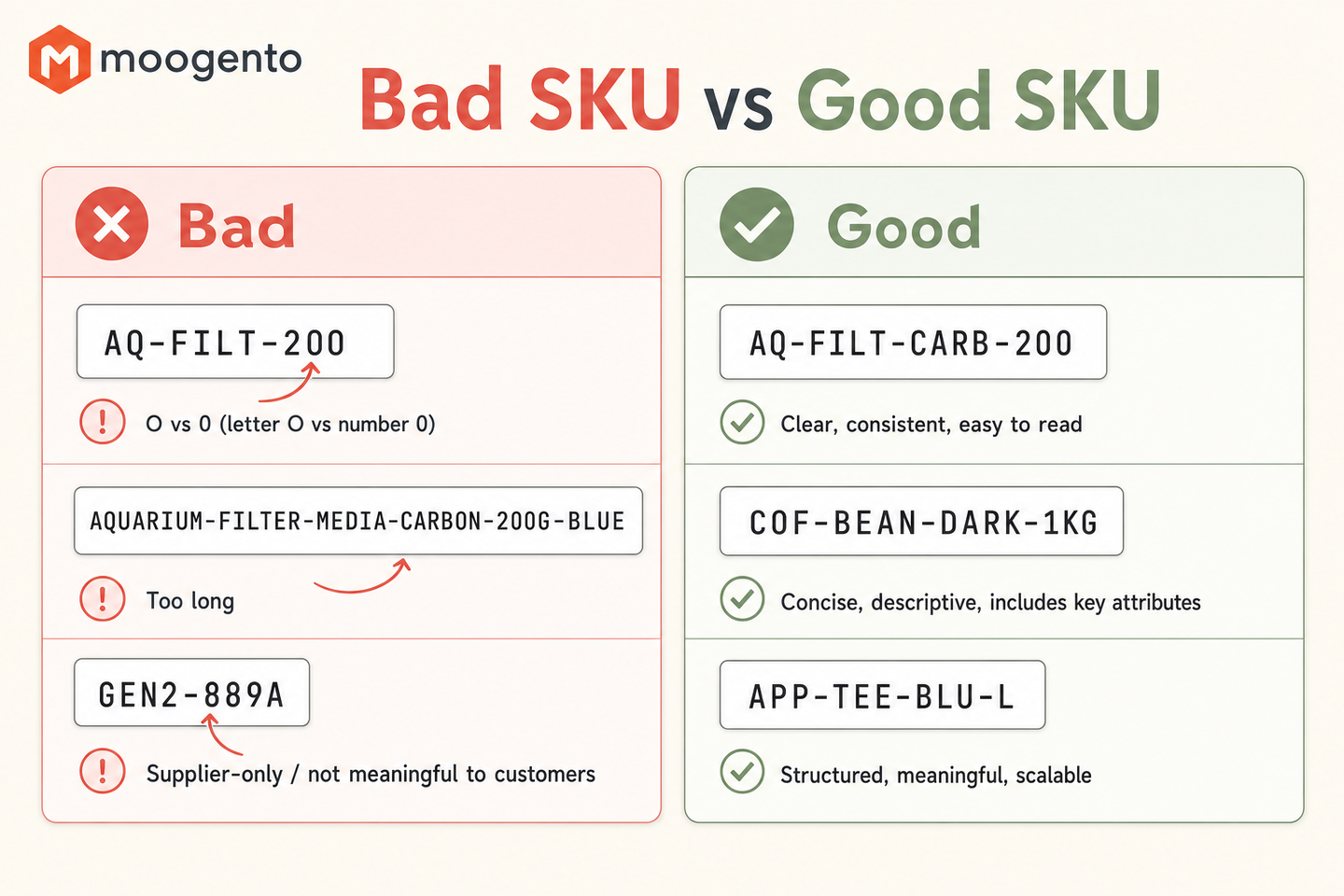
Most SKU problems fall into a handful of repeatable mistakes. Here's what they look like and what to do instead:
| Problem | Example | Why it hurts | Fix |
|---|---|---|---|
| Ambiguous characters | AQ-FILT-2OO |
Is that O or 0? Misread aloud, mistyped in search | Drop O, I, L from the alphabet you use; keep digits as digits |
| Too long | AQUARIUM-FILTER-MEDIA-CARBON-200G-BLUE |
Won't fit a shelf label, painful to read or type | Abbreviate to a fixed scheme: AQ-FILT-CARB-200 |
| Supplier-only meaning | GEN2-889A |
Your team can't tell what it is without a lookup | Lead with a category signal your staff recognise |
| No variant encoding | Two SKUs identical but for a hidden suffix | Pickers grab the wrong size or colour | Put the variant at the end where the eye lands: -BLU-L |
| Inconsistent separators | AQ_FILT/200.CARB |
Breaks search, breaks CSV imports, looks broken | Pick one separator (a hyphen) and never mix |
A simple SKU naming framework for Magento
You don't need a clever system. You need a consistent one. A structure that holds up across a catalogue is three segments, front to back, separated by a single hyphen:
- Category signal (2 to 4 characters): a prefix your staff recognise instantly.
AQfor aquarium,COFfor coffee,APPfor apparel. - Product identifier: the specific item, abbreviated consistently.
FILT-CARBfor carbon filter media. - Variant suffix: size, colour, or pack, always last, always the same order.
-200,-BLU-L.
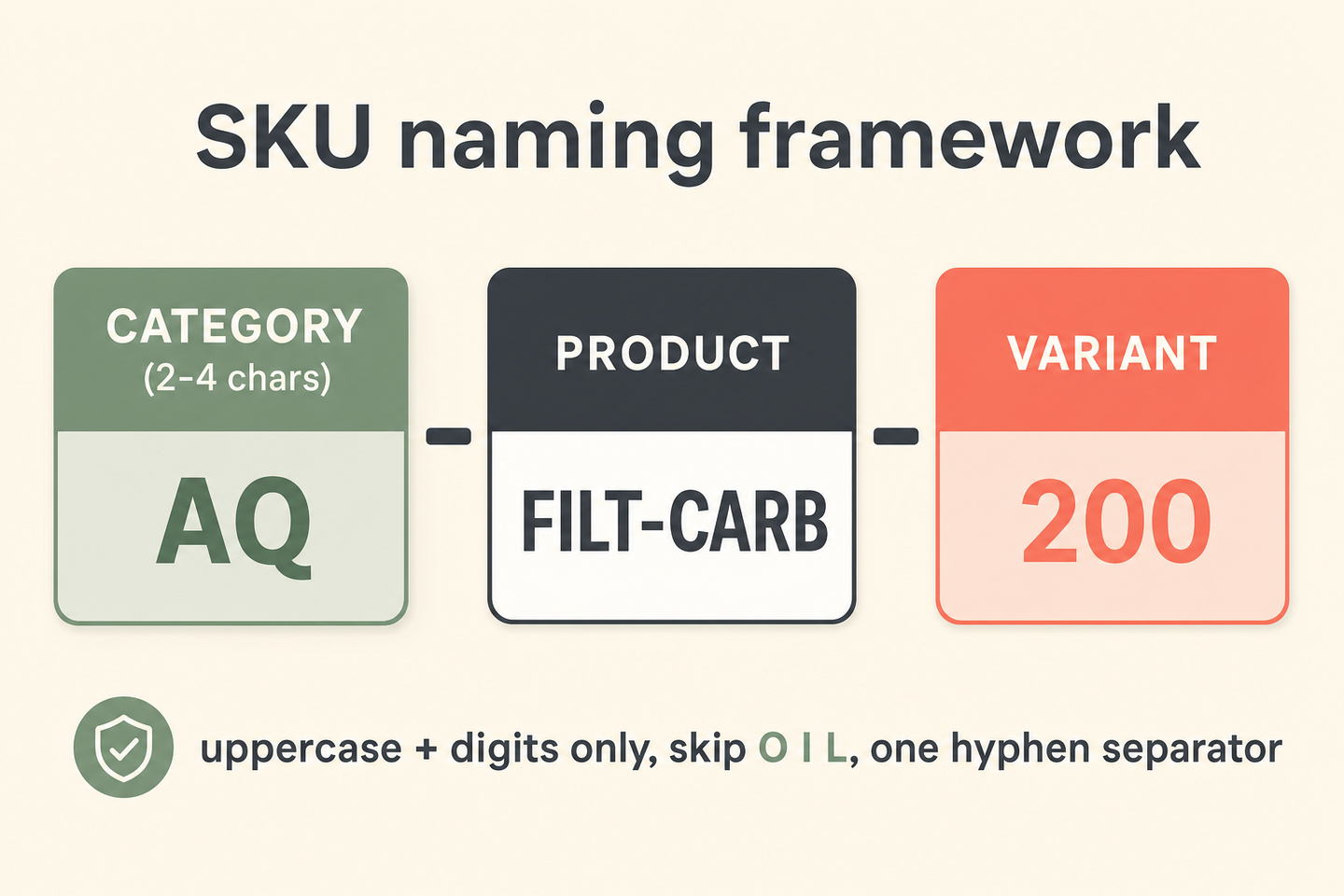
The result - AQ-FILT-CARB-200 - is short enough for a shelf label, readable aloud, unambiguous to type, and it sorts sensibly in the admin grid because related products share a prefix. Use only uppercase letters and digits, skip O/I/L to avoid confusion with 0/1, and keep the total length under about 20 characters so it fits everywhere it needs to.
The configurable product trap
This one quietly causes mispicks in Magento 2, so it's worth its own section. A configurable product has a parent SKU and a set of child (simple) SKUs - one per variant. When you scan or print, which SKU shows up?
By default, picking and packing documents and the scan match resolve to the child SKU - the specific simple product being shipped - because that's the thing actually leaving the shelf. That's usually what you want. The trap is a merchant who prints or labels the parent SKU on the product and then wonders why the scan won't match, or who assumes "the SKU" means the parent everywhere. Decide early: the variant-level (child) SKU is what your warehouse should see and scan, and your labels should carry it. Encode the variant into the child SKU so the two match by design.
How this applies to Magento 2
Magento 2 enforces SKU uniqueness and uses the SKU as the key for product imports and updates (Adobe's product workflow docs cover the create-and-import flow). That has a practical consequence: changing a SKU later is disruptive, because URLs, imports, integrations, and any external system keyed on it all have to follow. So the time to get SKU format right is before you bulk-load a catalogue, not after. As of Magento 2.4.9 there's no built-in SKU generator or format validator - the discipline is yours to enforce.
Two more Magento-specific points. First, if you use supplier barcodes rather than printing your own, the SKU and the scanned barcode are different values held in different fields, so the SKU is free to be human-friendly while a separate attribute holds the machine barcode. Second, keep separators clean: SKUs flow through CSV imports constantly, and a stray slash or space is the kind of thing that silently breaks a bulk update.
Where Moogento helps
A good SKU pays off most in the warehouse, which is where Moogento's fulfilment tools read it. PickPack prints the SKU on picking and packing PDFs, and for configurable products it shows the child SKU by default (with an option to show the parent instead) - so a clean, variant-encoded child SKU is exactly what lands on the pick document. If you also print the SKU as a barcode on those documents, a short, unambiguous SKU scans more reliably than a long one crammed into a narrow label.
StockEasy keys its stock and reorder data on the SKU too, and uses it in CSV import and export and in barcode-based stock counts. Consistent SKUs make those exports readable and those imports safe - a supplier price update matched on a clean SKU applies to the right products; matched on a messy one, it doesn't. The Moogento docs cover both modules if you want the field-level detail.
SKU format audit checklist
- Read ten random SKUs aloud. Any you hesitate on (O vs 0, I vs 1) are already causing errors.
- Check the longest SKU in your catalogue against your shelf label width. If it doesn't fit, your scheme is too long.
- Sort the product grid by SKU. Do related products cluster, or scatter? Clustering means your prefixes work.
- Pick a configurable product. Confirm the child SKUs encode the variant and match what's on the physical label.
- Search the admin for a partial SKU. If inconsistent separators return nothing, your format is fighting you.
- Find three supplier-coded SKUs. Rewrite them with a category prefix your staff would recognise.
- Confirm one separator across the whole catalogue. Mixed separators break imports and search.
FAQ
What is a good SKU format for Magento?
Short (under about 20 characters), uppercase letters and digits only, one consistent separator (a hyphen), structured as category prefix, product identifier, then variant suffix - for example AQ-FILT-CARB-200. Avoid O, I, and L so they aren't confused with 0 and 1. The same format should read well aloud, scan reliably, and sort sensibly in the admin.
Should a Magento SKU contain the variant?
Yes. For configurable products, encode size, colour, or pack into the child SKU as a consistent suffix. Magento resolves picking documents and scan matches to the child SKU by default, so a variant-encoded child SKU is what your warehouse actually sees - and it stops pickers grabbing the wrong size of an otherwise identical product.
Can I change a Magento SKU after products go live?
You can, but it's disruptive. The SKU is Magento's key for imports and updates, and external systems, integrations, and processes often key on it too. Changing it means every one of those has to follow. Get the format right before bulk-loading a catalogue rather than renaming thousands of products later.
Should the SKU be the same as the barcode?
Only if you print your own SKU barcodes. If you scan suppliers' existing UPC or EAN codes, keep those in a separate barcode attribute and let the SKU stay human-friendly. The SKU identifies the product for your team; the barcode attribute holds the machine-readable code the scanner matches.
Set the format before the catalogue grows. A consistent three-segment SKU is a one-time decision that quietly pays off every time someone picks, scans, searches, or imports - and a messy one is a tax you pay on all four forever.


