
Why Magento Review Requests Should Wait Until After Delivery

A Magento review request should arrive after the customer has received and used the product, not while the parcel is still in transit. Sending "how did we do?" before delivery asks someone to rate a box they haven't opened, which either gets ignored or produces a review about shipping rather than the product. The right delay is a few days after delivery, adjusted for how long the product takes to form an opinion about.
Why does review timing matter so much?
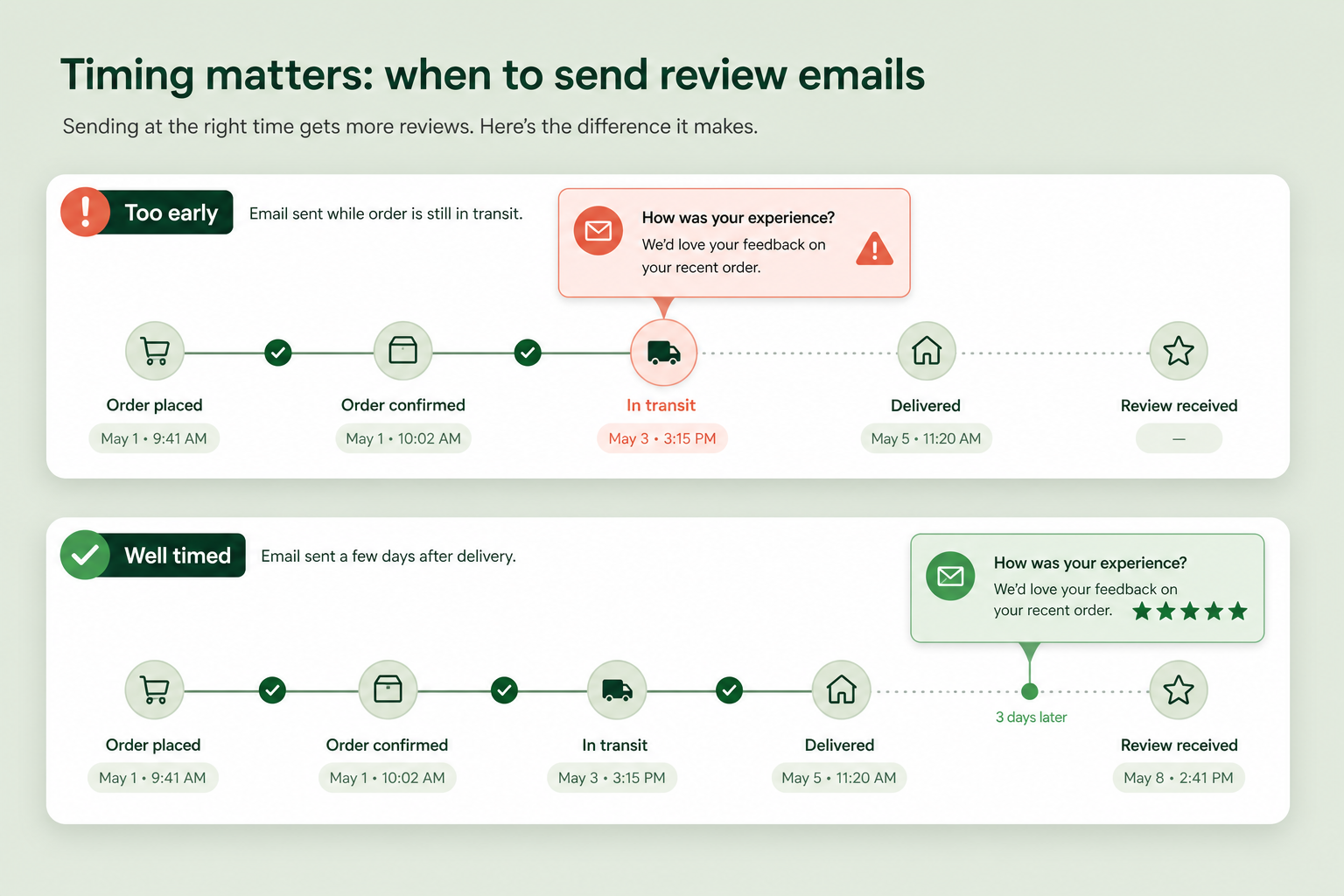
Because a review email is a single, one-shot ask, and its timing decides both the response rate and what the review is about. Send it too early and you either get silence or a one-star "still hasn't arrived". Send it far too late and the customer has forgotten the detail that would have made a useful review. There's a window - opened, used, opinion formed, still fresh - and hitting it is most of the job.
The failure mode is common enough to describe without naming names: an order confirmation that's immediately followed by a "review your purchase" email, triggered off the order date with no awareness of whether the item has shipped, let alone landed. The customer is being asked to review a product that is, at that moment, on a lorry. Reviews collected that way skew towards delivery complaints and drag your average down for reasons that have nothing to do with the product.
How long after delivery should you wait?
Wait long enough for the customer to actually use the product, which varies by category. A consumable is judged in a day; a piece of furniture needs assembling and living with. There's no single number, so set the delay by product type rather than applying one blanket offset to the whole catalogue.
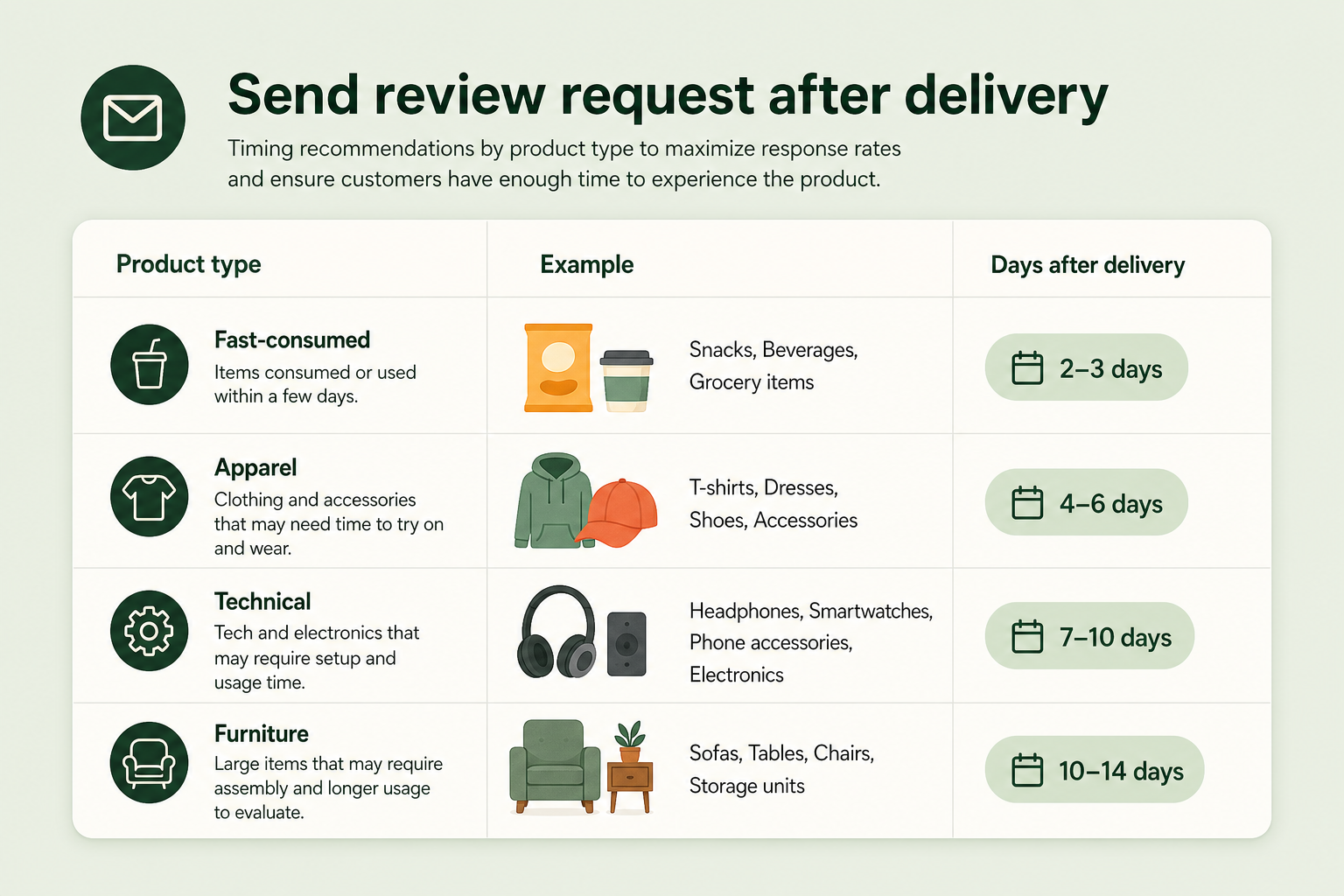
| Product type | Example | Send after delivery | Why |
|---|---|---|---|
| Fast-consumed | Food, supplements, pet treats | 2-3 days | Judged almost immediately; wait too long and it's used up and forgotten |
| Apparel | Clothing, shoes | 4-6 days | Needs trying on, maybe washing; leaves room for a return first |
| Technical | Electronics, tools, aquarium kit | 7-10 days | Needs setting up and using before a real opinion forms |
| Furniture / large | Flat-pack, homeware | 10-14 days | Assembly and daily use take time; early reviews are about the box, not the sofa |
One extra rule for slow categories: don't ask before a likely return would have happened. A review request that lands mid-return is awkward for everyone and usually goes unanswered. For apparel especially, sitting past the typical return window before asking lifts both response rate and review quality.
What does a well-timed review email look like?
Short, specific to the product ordered, and upfront about what it's asking. Name the item, ask about the thing a buyer of that item cares about, and make the star-rating action a single click. If you want photos, ask - a "add a photo" prompt lifts the usefulness of the review for the next shopper - but don't gate the review behind it.
Be careful with incentives. A small thank-you for any review is fine; a reward that only pays out for a five-star review is review-gating, it's against most platforms' policies, and customers can smell it. Ask for a genuine review, make it a single click, and time it well - that does more for volume than a bribe does.
How this applies to Magento 2
Magento 2's native review request is thin, and the timing problem is baked into how most setups trigger it. Out of the box there's no automated review email at all; bolt-on solutions typically fire off the order date, because that's the easy signal to read. The date Magento knows precisely is order created. The date you actually want - delivered - it doesn't natively know, because delivery status lives with the carrier.
So there are two levels of "delivery-aware" on Magento 2. The approximation: gate the review email on a shipment existing, then add a delay offset long enough to cover typical transit plus a use period - so an order that never shipped never gets asked, and one that shipped gets asked a sensible number of days later. The real version: read actual carrier delivery status and count the delay from the delivered date. The first is achievable with order and shipment data alone; the second needs live carrier tracking feeding the trigger.
Where Moogento helps
HelloCustomer handles the review-request side with the shipment-gated approximation. Its review reminder won't send for an order that hasn't shipped, and its nudge sequence waits before asking rather than firing the moment an order is placed. Just as usefully, it groups reviewable items across a customer's recent orders within a window (Stores > Configuration > Moogento HelloCustomer, review-reminder grouping days, default 7) into one email rather than sending a separate request per product - so a customer with three recent orders gets one ask, not three. That grouping is the difference between a review programme and a nuisance.
To set expectations at the front of the journey, ThanksEasy puts estimated shipped-by and delivered-by dates on the order confirmation page (you configure the day offsets), so the customer knows roughly when to expect the parcel - and, by extension, when a review ask would make sense. And for the harder version of the trigger, TrackEasy is the module that actually knows delivery status: it polls carrier APIs and maintains a per-shipment delivered flag and estimated-delivery date. If your goal is to count the review delay from real delivery rather than from dispatch plus a guess, that delivered signal is where it comes from.
One limit worth stating: HelloCustomer times its review reminder from the order date with a shipment gate and a delay, not from a carrier "delivered" event. That's a deliberate approximation - it holds up well and needs no carrier integration - but if you want true delivered-date timing, that's a tracking-driven build, not a default.
Review timing audit checklist
- Place a test order and note the gap between the order date and the review email. If a review ask can arrive before dispatch, your trigger is order-date-only.
- Check the email is gated on a shipment existing, so orders that never ship never get asked.
- Set the delay by product category, not one blanket offset. Consumables days, furniture a fortnight.
- For apparel, make sure the ask lands after the typical return window, not during it.
- Confirm a customer with several recent orders gets one grouped email, not one per product.
- Read the email copy: does it name the product and ask about the thing that matters for that item?
- Check you're asking for a genuine review, not gating a reward on five stars.
- If you need true delivered-date timing, confirm something is actually feeding carrier delivery status into the trigger.
FAQ
When should a Magento store send a review request email?
After the customer has received and used the product - a few days after delivery for consumables, up to a fortnight for furniture. The key is to gate the email on the order having shipped and add a delay that covers transit plus a short use period, so the review is about the product rather than the parcel's journey.
Why not send the review request straight after purchase?
Because at purchase the customer hasn't received anything to review. An early request either gets ignored or produces a review about shipping and delivery instead of the product, which drags your average rating down for reasons unrelated to product quality.
Can Magento tell when an order was actually delivered?
Not natively. Magento knows the order and shipment dates precisely, but delivery status lives with the carrier. To time a review email from the real delivered date you need carrier tracking feeding the trigger. A common, reliable approximation is to gate the email on a shipment existing and add a delay offset that covers typical transit.
Should you offer a discount for leaving a review?
A small thank-you for any review is fine. Rewarding only positive or five-star reviews is review-gating, it breaches most review platforms' policies, and customers notice. Better timing and a one-click ask do more for review volume than an incentive does.
Get the trigger off the raw order date first. Gate on shipment, delay by category, group per customer - that alone turns a review programme from a source of shipping complaints into a source of product reviews worth reading.