
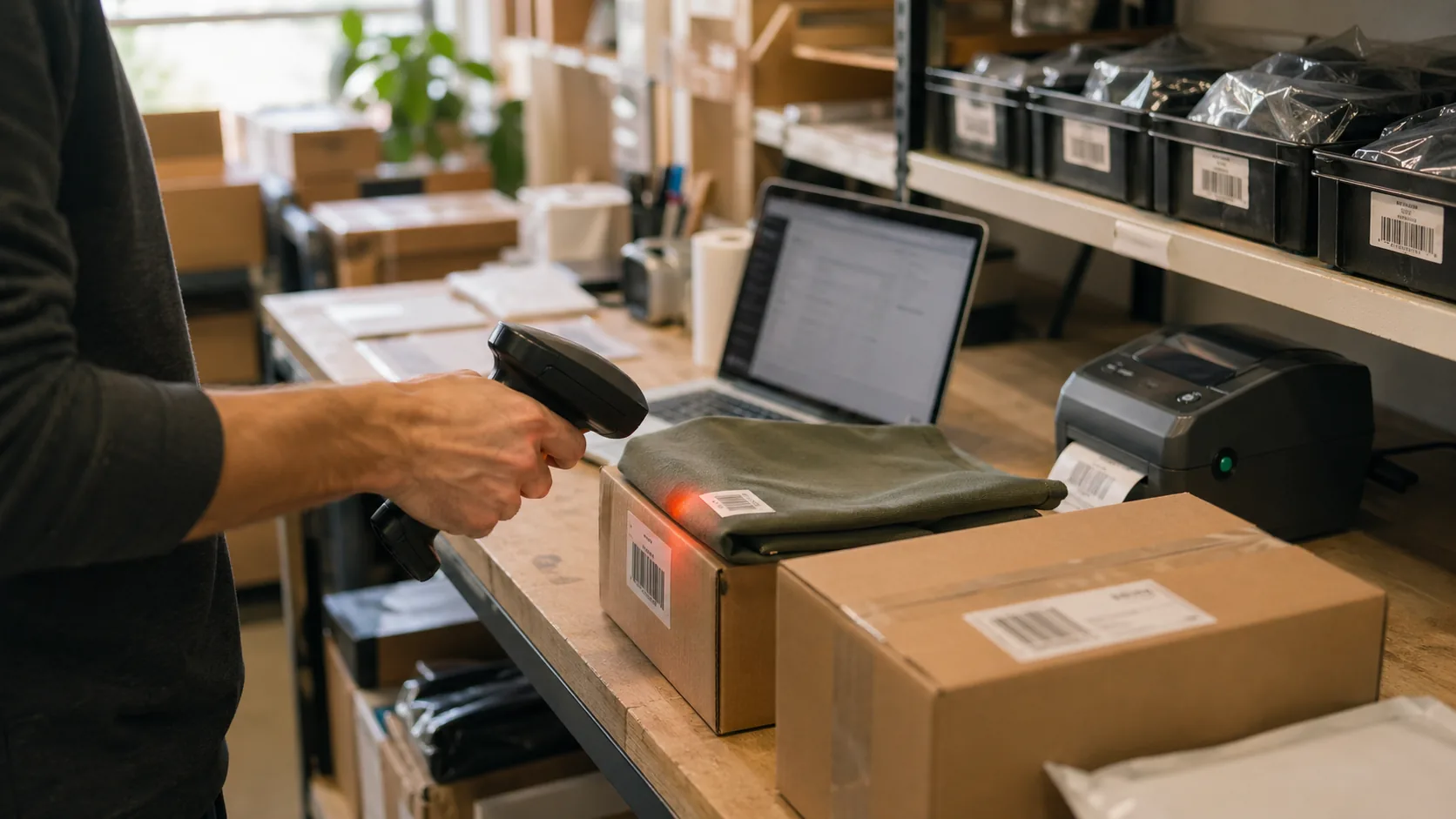
Overview
Most Magento operations - picking, packing, stock counts, returns - get faster the moment you stop typing SKUs.
A barcode scanner is the cheapest, fastest upgrade most warehouses can make.
But Magento isn't a warehouse system out of the box, and "barcode scanner" covers a confusing range of devices.
The key point: A barcode scanner is just a fast keyboard. The work is in the workflow you point it at.
This guide explains how to choose, set up, and use barcode scanners with Magento 2.
How Barcode Scanners Work With Magento
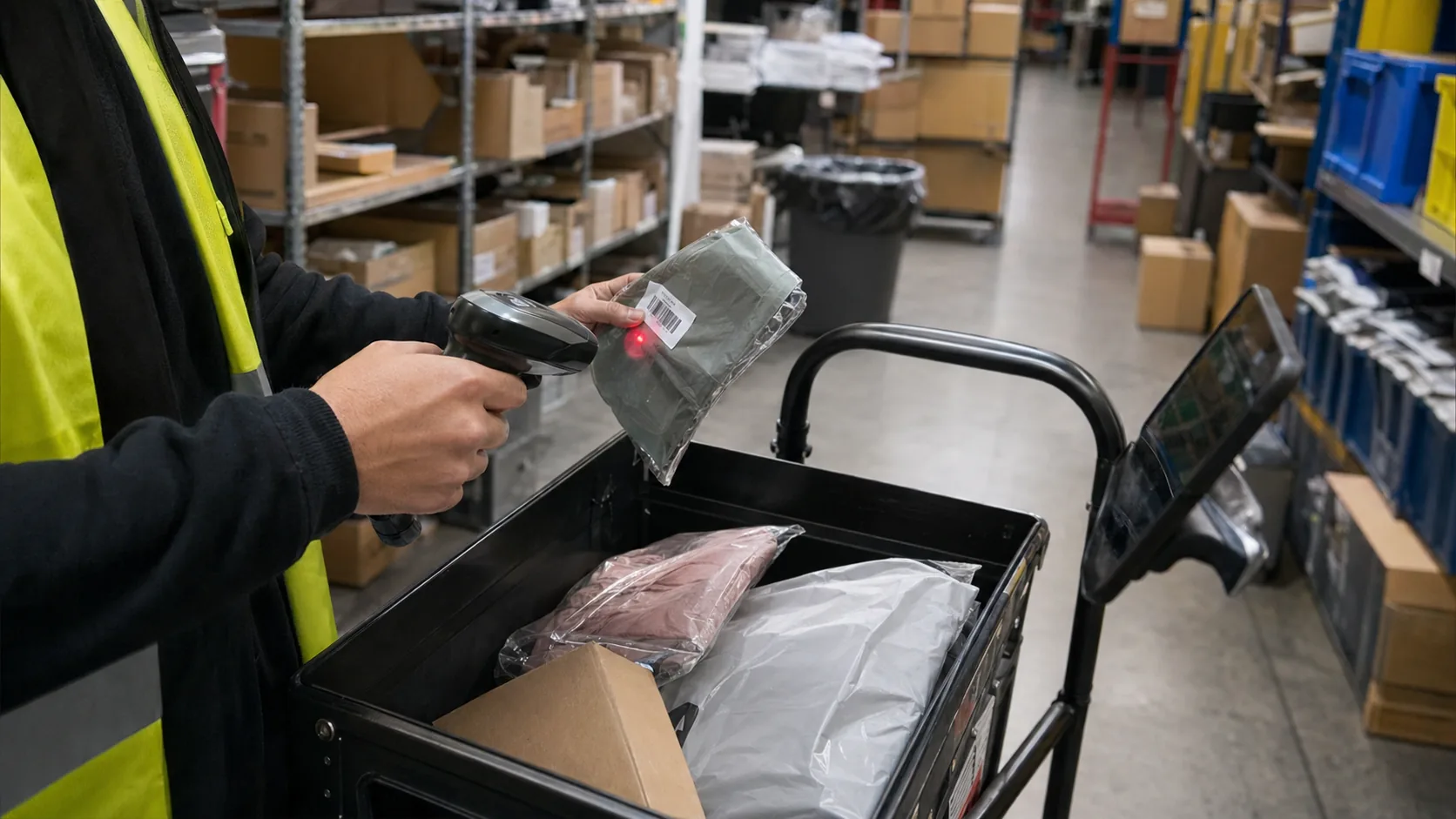
Almost every consumer or commercial barcode scanner emits the scanned value as keyboard input.
Scan a barcode → The scanner types the contents into whatever field is focused → Optionally appends an Enter key.
This means any Magento admin field that accepts text can take a scan:
- Product search box
- SKU field on a quote / order
- Stock adjustment forms
- Custom Moogento operations panels
No driver setup required. No special integration. The browser sees keystrokes.
Types of Barcode Scanner
1. Wired USB Scanners
The workhorse.
- Plug-and-play
- No batteries
- Cheap (£20-£60)
- Reliable for fixed packing stations
Best when the scanner stays at a desk.
2. Bluetooth Scanners
Mobile, but tethered to a paired device.
- Good for slow, careful aisles
- Battery life can surprise (in both directions)
- Pairing can drop on heavy use
Best for one-person operations who don't want to drag a cable around.
3. Wi-Fi / Mobile Computer Scanners
Industrial gun-style devices (Zebra TC, Honeywell CT) that run their own browser.
- Most expensive (£400+)
- Most rugged
- Best when picking volume justifies dedicated hardware
Best for high-volume warehouses with several pickers.
4. Phone Camera Scanning
Modern phone cameras decode barcodes well via:
- A web-based JavaScript scanner (e.g. ZXing)
- Native camera scanning
- Dedicated apps
Cheap, available, no extra hardware - but slower than a laser scanner once you're scanning hundreds of items.
Best for occasional scans, small stores, or returns desks.
Barcode Symbologies (What Type of Code)
Most retail barcodes are one of:
EAN-13 / UPC-A
The 13- or 12-digit codes on retail products. Universal across supermarkets and most consumer goods.
Magento doesn't generate these. They're issued by GS1.
Code 128
A dense barcode often used for internal SKUs and shipping labels.
PickPack and most carrier label PDFs use Code 128.
Code 39
Older, simpler, less dense. Common on internal labels at smaller warehouses.
QR Codes (2D)
Useful when you need to encode more than a SKU - e.g. a URL, a serial number, or a small JSON payload.
Almost all modern scanners read both linear and QR codes.
Step-by-Step: Setting Up Scanners With Magento
Step 1 - Pick the Scanner Type
Match scanner to workflow:
- Packing desk → wired USB
- Small warehouse → Bluetooth
- High volume → Wi-Fi mobile computer
- Returns desk → phone camera
Step 2 - Configure Scan Suffix
Most scanners can append a key after each scan:
- Enter (most common - submits forms)
- Tab (moves to next field)
- None (pure character input)
Pick the suffix that matches your workflow.
For Magento product search: Enter is usually right.
Step 3 - Choose Where Scans Land
Decide which page handles the scan:
- A custom admin panel (PicknScan)
- A Magento order detail page
- A stock adjustment form (StockEasy)
- A pick list (PickPack)
The scanner doesn't care. Your workflow does.
Step 4 - Print Internal Barcodes for SKUs
Magento doesn't give you EAN codes - you need a barcode for each internal SKU.
PickPack generates Code 128 barcodes from any product attribute (usually sku).
Print these on:
- Packing slips
- Bin labels
- Returns tickets
Step 5 - Train the Workflow
A scanner without a workflow is just a faster typo machine.
Document:
- Which page is open at each step
- What gets scanned and in what order
- What happens after the final scan
Test with the slowest member of the team. If they can do it, the workflow is solid.
Barcode Workflows That Actually Save Time
1. Pick & Pack Verification
For every order:
- Print a packing slip with a Code 128 barcode of the order ID
- For each line, print the SKU barcode
- Scanner scans the order ID → opens the Magento order
- Scanner scans each item → ticks it off the pick list
Result: orders shipped without the wrong product.
2. Stock Counts
For each shelf:
- Scan the SKU
- Type the quantity
- Move to next SKU
A team can count an entire warehouse in a fraction of the time spreadsheets take.
StockEasy is built for exactly this loop.
3. Receiving Goods
When new stock arrives:
- Scan the supplier's barcode (or your own)
- Increment received quantity
- Print updated bin labels if quantities changed bin
4. Returns Desk
Customer brings back an item:
- Scan the order barcode on the receipt
- Scanner opens the order
- Scan the SKU to identify the line
- Initiate the return without typing anything
Common Scanner Mistakes
Mistake 1 - Scanner But No Barcodes
Buying scanners before printing barcodes on packing slips and bin labels.
PickPack solves the printing side. Most stores need both.
Mistake 2 - Wrong Symbology for the Use Case
Using QR codes where you need a fast linear scan, or Code 39 where Code 128 would be denser.
Match the symbology to the device and the volume.
Mistake 3 - No Suffix Configured
The scan inputs the SKU but doesn't submit. Pickers manually press Enter every time. Slow and error-prone.
Set the scanner to append Enter once and forget it.
Mistake 4 - Single Camera Bottleneck
Phone cameras work for low volume.
A team scanning hundreds of items per hour will hate them. Get real scanners.
Mistake 5 - No Failure Path
What happens when a barcode is unreadable?
The workflow needs a manual entry path. Otherwise the whole operation stalls when one label gets damaged.
Where Moogento Fits
Three Moogento modules are barcode-aware:
- PickPack - prints Code 128 (and PDF417, QR) barcodes on invoices, packing slips, and any custom template
- PicknScan - admin scanner panel that turns scanned barcodes into Magento order and stock actions
- StockEasy - barcode-driven stock counts and adjustments straight from a phone or USB scanner
All three work with the simple "scanner = fast keyboard" model. No custom drivers, no separate apps.
Real-World Impact
Stores that pair barcodes with the right workflow typically see:
- Pick-and-pack errors fall sharply
- Stock counts go from days to hours
- Returns processing time cut by 50%+
- Less reliance on tribal knowledge ("I know which one that is")
FAQs
Do barcode scanners need a special Magento extension?
No - most scanners type into the focused field, so any Magento admin search box works. Modules like PicknScan add purpose-built scanning panels.
What barcode format should I print on Magento packing slips?
Code 128 is the safest default - dense, widely supported by scanners and label printers.
Can I scan barcodes with a phone instead of buying scanners?
For low volume, yes. For warehouse-scale operations, dedicated scanners are dramatically faster.
How do I generate barcodes for my SKUs in Magento?
PickPack generates Code 128, QR, and PDF417 barcodes from any product attribute - usually sku.
Can a Bluetooth scanner work across the whole warehouse?
Bluetooth has a short range and pairs to one device. For multi-zone warehouses, Wi-Fi mobile computers are a better fit.
Next Steps
To bring barcodes into your Magento operation:
- Decide which workflows benefit (picking, counts, returns)
- Pick scanners that match the volume and physical layout
- Print Code 128 barcodes on every packing slip and bin label
- Configure the scanner suffix to match the workflow
- Pilot one workflow before rolling out the others
Barcodes don't replace process - they amplify it. Apply them to a clear workflow and the speed gain is immediate.
 Magento 2 Quick Setup Check: A Post-Install Audit Every Store Should Run
  Magento 2 SEO Guide (2026): How to Rank Higher and Drive More Organic Traffic
  How AI Agents Discover, Rank, and Recommend Magento Content (2026 Guide)